Charcoal grills deliver the high-heat sear capability and smoke flavor depth that gas and pellet grills can’t fully replicate — and 2026 brought a genuinely new option worth considering: Weber launched the Performer Smart, the brand’s first charcoal grill with Wi-Fi–enabled LCD temperature control and a digitally-controlled fan that holds 225°F overnight without touching the vents. For most backyards, the Weber Original Kettle Premium at $219 remains the most rational buy; the Kamado Joe Classic Joe III is the upgrade for serious low-and-slow cooks who want lifetime ceramic coverage and a 225–750°F+ range in one grill.
| Spec | Weber Original Kettle Premium Charcoal Grill 22-Inch 9.2/10 | Weber Performer Smart 22-Inch Charcoal Grill 9/10 | Kamado Joe Classic Joe Series III 18-Inch Charcoal Grill Unavailable 9.4/10 | PK Grills PK300-SCX Original Charcoal Grill and Smoker 8.8/10 | Char-Griller AKORN Kamado Charcoal Grill E16620 8.3/10 |
|---|---|---|---|---|---|
| cooking_area | 363 sq in | 363 sq in | 510 sq in (18-inch diameter grates) | 300 sq in | 447 sq in total (314 sq in primary + 133 sq in warming rack) |
| material | Porcelain-enameled steel | — | Ceramic shell with stainless steel grates | Cast aluminum (rust-proof) | Triple-walled steel with cast iron grates |
| heat_control | Two adjustable dampers + built-in lid thermometer | — | — | — | — |
| weight | 32 lbs | — | 282 lbs | 40 lbs | 97 lbs |
| warranty | 10 years (bowl, lid, center ring) | 10 years (bowl, lid) | Lifetime (ceramic), 5-year (metal), 3-year (electronics) | 20 years on cast aluminum body | 1-year limited |
| assembly | 30–45 minutes | — | — | — | — |
| Rating | 9.2/10 | 9/10 | 9.4/10 | 8.8/10 | 8.3/10 |
Prices change daily — tap Check Price for the current Amazon price.
Prices change daily — tap Check Price for the current Amazon price.
Quick Picks
- Best Overall: Weber Original Kettle Premium 22” — 363 sq in, 10-year warranty, One-Touch cleaning, and $219 pricing cover the core use case for most buyers
- Best Smart Grill (New 2026): Weber Performer Smart 22” — Weber’s first Wi-Fi charcoal grill; digital fan holds 225°F overnight without manual vent adjustment
- Best Ceramic Kamado: Kamado Joe Classic Joe III — 225°F to 750°F+ range, 510 sq in, lifetime ceramic warranty, 3-tier cooking system
- Best Cast Aluminum: PK Grills PK300-SCX — rust-proof cast aluminum, 20-year warranty, 4 independent vents, 40 lbs portable
- Best Budget Kamado: Char-Griller Akorn E16620 — triple-walled steel kamado-style at $400 with 447 sq in total cooking area
Buying Guide: What to Know Before Choosing a Charcoal Grill

Kettle vs. Kamado vs. Cast Aluminum
Charcoal grills split into three structural categories, each with distinct trade-offs:
Kettle grills (Weber Kettle, Performer Smart) use porcelain-enameled steel over a rounded bowl. They heat fast, cost less, and weigh under 35 lbs. The trade-off is heat retention — steel loses temperature quickly when the lid opens, and thin walls mean high-heat searing burns through charcoal faster. Weber’s kettle design has been functionally unchanged since the 1950s because it works effectively at its price point.
Ceramic kamados (Kamado Joe Classic III) use thick ceramic shells that absorb and re-radiate heat rather than losing it immediately. A properly loaded ceramic kamado at 225°F holds temperature for 16–20 hours on a single charcoal load. The same grill at 750°F produces surface temperatures comparable to a commercial pizza oven. The trade-offs: $1,550+ price, 200+ lb weight, and a learning curve on vent management.
Steel kamados (Char-Griller Akorn) and cast aluminum (PK Grills PK300) sit between kettles and ceramic in heat retention, price, and portability. The Akorn delivers kamado-style cooking at kettle pricing; the PK300 trades cooking area for rust-proof durability and genuine portability.
Cooking Area: What You Actually Need
- 1–2 people: 250–300 sq in handles weeknight cooking without overcrowding
- Family of 4: 300–363 sq in (Weber Kettle) covers most sessions without batch cooking
- Entertaining 6+ people: 450–510+ sq in (Kamado Joe Classic III: 510 sq in) for a full spread without rotating batches
Manufacturers report “total cooking area” by adding every surface — primary grate, warming racks, and upper levels. For ribs, whole chickens, or brisket, only the primary grate dimensions matter. The Char-Griller Akorn lists 447 sq in total but the primary grate is 314 sq in — plan based on primary dimensions.
Charcoal Type and Temperature Range
Lump charcoal burns hotter and cleaner with less ash than briquettes — the preferred choice for kamados where ash accumulation restricts the bottom vent faster. Briquettes burn longer and more evenly at lower temperatures, making them better for extended kettle-based smoking with an indirect setup.
Temperature targets by cooking style:
- 225–275°F: Brisket, pork shoulder, ribs (low-and-slow)
- 375–425°F: Chicken, vegetables, fish (medium-high indirect)
- 500–700°F+: Steaks, burgers, pizza (high-heat direct)
Ceramic kamados cover all three ranges in a single unit. Kettle grills perform best at medium to high heat; achieving stable 225°F requires precise vent work and practice.
Vent Design and Temperature Control
Every charcoal grill on this list controls heat through vents: more open = more oxygen = higher heat; more closed = less oxygen = lower heat and more smoke.
| Grill | Vent System |
|---|---|
| Weber Kettle Premium | 2 vents (top + bottom dampers) |
| Weber Performer Smart | Digital fan replaces manual vent work entirely |
| Kamado Joe Classic III | Side bottom vent + Kontrol Tower top vent |
| PK Grills PK300 | 4 independent vents (2 intake, 2 exhaust) |
| Char-Griller Akorn | Adjustable top + bottom dampers |
The Weber Performer Smart eliminates manual vent adjustments — its digitally-controlled fan handles oxygen regulation to maintain the set temperature. The PK300’s four-vent system provides the most granular manual control for 2-zone setups.
Weather Resistance and Maintenance
All five grills handle outdoor exposure year-round, but maintenance requirements differ:
- Weber Kettle/Performer: Porcelain enamel resists rust well; the Performer’s steel cart can show surface oxidation at weld joints after multiple winters without a cover
- Kamado Joe: Ceramic is impervious to moisture; the felt gasket degrades faster in wet climates and needs replacement every 3–5 years
- PK Grills: Cast aluminum is structurally rust-immune — no cover required, no seasonal storage necessary
- Char-Griller Akorn: Triple-walled steel requires a quality grill cover in wet climates; weld seams are the long-term failure point
A grill cover costs $30–$50 and extends any steel grill’s lifespan significantly. Budget for one with any steel or porcelain purchase.
Assembly Time
- Weber Kettle Premium: 30–45 minutes, minimal tools
- Weber Performer Smart: 1.5–2 hours, cart assembly involved
- Kamado Joe Classic III: 2–3 hours, 282 lbs — plan for two people
- PK Grills PK300-SCX: 30–45 minutes, stand snaps together
- Char-Griller Akorn: 45–60 minutes, standard hardware kit included
Warranty Comparison
| Grill | Warranty |
|---|---|
| Weber Original Kettle Premium | 10 years (bowl, lid, center ring) |
| Weber Performer Smart | 10 years (bowl, lid) |
| Kamado Joe Classic III | Lifetime (ceramic), 5-year (metal), 3-year (electronics) |
| PK Grills PK300-SCX | 20 years (cast aluminum body) |
| Char-Griller Akorn E16620 | 1 year limited |
Warranty length reflects expected product lifespan. The Kamado Joe and PK Grills are designed as multi-decade purchases; the Char-Griller Akorn is not.
Detailed Reviews
Weber Original Kettle Premium Charcoal Grill 22-Inch

The Weber Kettle’s design has been functionally unchanged since the 1960s — the clearest endorsement possible from the market. The 22-inch porcelain-enameled bowl, top and bottom vents, hinged grate for mid-cook fuel additions, and One-Touch cleaning system make it the reference point every competing kettle is measured against.
The Premium adds a built-in lid thermometer and a porcelain-enameled ash catcher versus the standard model. At $219, it’s the floor for charcoal grilling done correctly — the lid fits snugly, the vent dampers hold position without drifting, and the bowl retains enough heat for high-temperature direct grilling and basic indirect smoking.
Weber’s 10-year warranty on the bowl, lid, and center ring is backed by a genuine parts ecosystem — cooking grates, ash catchers, and dampers are available individually, so a single failed component doesn’t force a full replacement. Owner reports on r/grilling and Weber’s own community forums consistently describe the Original Kettle Premium lasting 10–15+ years with normal care.
Best for: First-time charcoal grillers, buyers who prioritize value, and households that grill 2–4 times per month without specialized smoking needs.
Weber Performer Smart 22-Inch Charcoal Grill

Weber introduced the Performer Smart in 2026 as the brand’s first Wi-Fi–enabled charcoal grill — a direct response to the temperature-control advantages pellet grills have held over charcoal for years. The central addition is a digitally-controlled fan that regulates oxygen input to the coal bed, holding the set temperature without manual vent adjustment. At 225°F for an overnight brisket, the fan manages what a traditional pitmaster does manually every 30–45 minutes.
Rapidfire Assist uses the same fan to accelerate coal ignition without a chimney starter. Load the basket, activate the mode, and the fan speeds ignition while preheating the cooking surface — a practical time reduction on weeknight cooks where a 15-minute chimney warmup adds friction.
The Weber Works side rail accepts a snap-on accessory system (sold separately) including paper towel holders, utensil racks, and condiment holders. The prep table provides actual workspace adjacent to the grill — something the standard Kettle’s tripod cart completely lacks.
The $380 premium over the Original Kettle is entirely attributable to the smart system and cart. The cooking area is identical at 363 sq in, and the bowl and lid construction is the same porcelain enamel. The question is whether digital temperature hold and Rapidfire Assist justify the difference for your cooking frequency and use case.
Best for: Buyers who want charcoal flavor with pellet-grill temperature consistency, or cooks who want to eliminate active vent management during long sessions.
Kamado Joe Classic Joe Series III 18-Inch Charcoal Grill
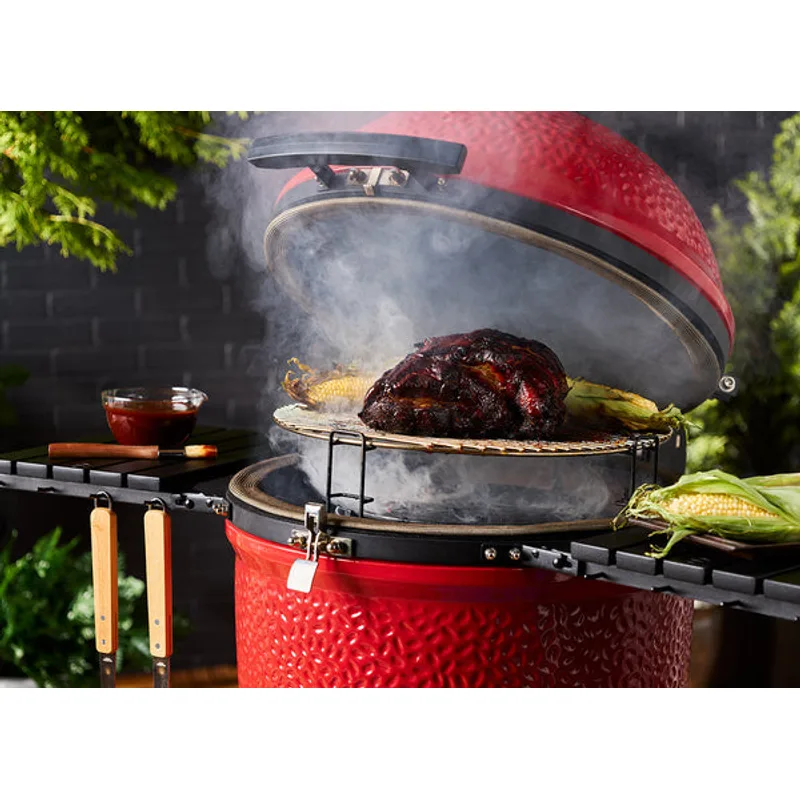
Kamado Joe Classic Joe Series III 18-Inch Charcoal Grill
The Kamado Joe Classic Joe III is the standard-setting ceramic kamado in the sub-$1,500 category. The 18-inch ceramic shell holds temperature through mechanisms that steel grills can’t replicate — once stabilized at 225°F, the ceramic re-radiates stored heat back into the cooking chamber rather than losing it to surrounding air. Owner reports across multiple BBQ communities consistently describe 16–20 hour cooks on a single charcoal load without meaningful temperature drift.
The SloRoller hyperbolic smoke chamber insert (included with the Series III) routes combustion gases in a spiral pattern across the cooking surface before exhausting through the top vent. This increases smoke exposure time versus a flat deflector plate — producing more pronounced smoke ring development on brisket and ribs, according to Kamado Joe’s published airflow data and corroborated by owner cook logs.
The Divide & Conquer 3-tier system provides half-grate configurations at three heights, enabling simultaneous direct and indirect cooking zones in the same 510 sq in chamber. Searing chicken thighs over direct coals while holding a whole salmon at indirect 350°F in the same session is a realistic workflow — not possible in a single-zone kettle without cycling food through in batches.
At $1,550 with a lifetime ceramic warranty, the Kamado Joe Classic III is a 20-year purchase for regular cooks, not a 5-year one. The investment is justified by cooking frequency — daily or weekly use over two decades makes the per-session cost competitive with any grill on this list.
Best for: Serious BBQ enthusiasts, anyone who regularly cooks brisket or pork shoulder, and buyers who want a single grill covering everything from low-and-slow smoking to high-heat pizza.
PK Grills PK300-SCX Original Charcoal Grill and Smoker

PK Grills PK300-SCX Original Charcoal Grill and Smoker
The PK300 occupies a specific niche: rust-proof, portable charcoal grilling with better 2-zone control than a standard kettle. The oval cast aluminum capsule distributes heat differently than a round steel bowl — the shape creates a natural hot zone directly over the coal bed and a cooler indirect zone at the far end without requiring a deflector plate.
The four-vent system (2 intake at the bottom, 2 exhaust at the top) provides independent control of each end of the grill. Closing the far intake and opening the near intake pushes heat toward one side; reversing the combination shifts the hot zone. This level of precision exceeds a standard kettle’s single-bottom-vent setup and produces more consistent 2-zone temperature differentials for simultaneous direct/indirect cooking.
At 40 lbs, the PK300 is genuinely portable — it disassembles without tools, and the stand stores flat. Every other grill over 300 sq in on this list weighs 90+ lbs. That weight advantage matters for tailgating, camping with vehicle access, or seasonal storage in a garage or shed.
The 20-year warranty on the cast aluminum body is the primary long-term value argument. Cast aluminum does not rust, pit, or corrode under outdoor conditions — no maintenance regimen required, no replacement parts for weathering damage. Over 20 years, the maintenance savings on a steel grill potentially approach the price premium versus a standard kettle.
Best for: Buyers prioritizing rust-proof durability and portability, tailgaters, and small households where 300 sq in is sufficient for regular use.
Char-Griller AKORN Kamado Charcoal Grill E16620
The Char-Griller Akorn delivers kamado-style thermal performance at kettle grill pricing. The triple-walled steel construction — an inner steel wall, an insulating air gap, and an outer shell — holds heat more efficiently than a single-wall kettle without the weight penalty of ceramic. Owner reports across barbecue communities describe temperature stabilization comparable to entry-level ceramic kamados after the initial warmup period, with temperature swings within ±25°F at smoking temperatures once the grill reaches equilibrium.
Cast iron cooking grates retain heat better than chrome-plated steel and develop a natural non-stick quality with regular seasoning and use. The 314 sq in primary grate handles a full rack of ribs or 4–5 large burgers; the 133 sq in warming rack stages finished food at lower temperatures while the next batch cooks.
The locking lid is a practical differentiator at this price. At 225°F for a long smoke, even a small lid gap creates significant heat loss and temperature instability — the Akorn’s locking mechanism maintains a tighter seal than most budget grills. The 8-inch locking casters allow repositioning a 97-lb grill without lifting it.
The 1-year warranty is the honest limitation. Triple-walled steel corrodes at weld seams over time; Char-Griller’s coverage doesn’t extend past the failure modes that appear after 3–5 years of high-heat use. A quality grill cover used consistently extends the Akorn’s practical lifespan significantly.
Best for: Budget-conscious buyers who want kamado-style heat retention, entry-level BBQ enthusiasts, or anyone who wants 447 sq in of cast iron cooking surface without paying ceramic-kamado prices.
FAQ
What is the difference between a kettle grill and a kamado?
A kettle grill uses a thin porcelain-enameled steel bowl with a domed lid. It heats fast, costs less, and weighs under 35 lbs. It performs well for high-heat grilling but loses temperature quickly when opened and burns through charcoal faster at sustained high heat. A kamado uses a thick ceramic (or insulated steel) shell that absorbs and re-radiates heat — holding temperature far more steadily for low-and-slow cooking while also reaching 700°F+ for searing and pizza. Kamados cost more, weigh significantly more, and require more practice to dial in, but offer a wider cooking range in a single unit.
Can you smoke on a Weber Kettle without a dedicated smoker?
Yes. Set up a 2-zone fire by pushing lit coals to one side, place a water pan under the indirect side, add wood chunks over the coals, and close the lid with both vents at 20–25% open. This configuration holds 225–275°F for 3–4 hours before requiring additional fuel. It’s not as hands-off as a dedicated smoker or the Weber Performer Smart’s digital fan, but owner reports from the Weber community consistently describe successful ribs, whole chicken, and pork shoulder cooks using this method.
Is lump charcoal or briquettes better for grilling?
For high-heat direct grilling (500°F+), lump charcoal burns hotter and cleaner with less ash — preferred for quick sessions. For low-and-slow smoking (225–275°F) over multiple hours, briquettes provide a more even, sustained burn with more predictable timing. In ceramic kamados, lump charcoal is strongly preferred — the lower ash output prevents airflow restriction at the bottom vent during long cooks. In a standard kettle for weeknight grilling, either works adequately.
How do you control temperature on a charcoal grill?
Through airflow management via vents. Open vents increase oxygen, raising temperature; closed vents restrict oxygen, lowering temperature. On a standard kettle: the bottom vent controls primary oxygen input; the top vent controls draft and smoke direction. For smoking at 225°F, set both vents to roughly 15–25% open. For high-heat grilling at 500°F+, open both fully. The Weber Performer Smart replaces this entirely with a digitally-controlled fan that adjusts airflow automatically to hold any set temperature.
What charcoal grill size do I need?
For 1–2 people: 250–300 sq in (PK Grills PK300: 300 sq in) covers regular use. For a family of 4: a 22-inch kettle at 363 sq in handles most sessions without batch cooking. For entertaining 6+ people: 450–510 sq in (Kamado Joe Classic III: 510 sq in) allows cooking a full spread simultaneously. If you regularly cook large whole cuts — packer briskets, spatchcocked turkey — prioritize primary grate dimensions over the manufacturer’s “total cooking area” figure, which includes warming racks.
How long does charcoal last in a grill during a cook?
In a standard kettle for direct grilling at 450–500°F, a standard chimney load lasts 45–60 minutes. For indirect smoking at 225°F in a kettle, the same load extends to 2–3 hours. In a ceramic kamado at 225°F, a full load of lump charcoal sustains temperature for 16–20 hours due to the ceramic’s superior heat retention and reduced charcoal consumption. The Kamado Joe Classic III’s ceramic efficiency is the primary operating cost justification over steel alternatives for long-duration cooks.
The Bottom Line
For most buyers, the Weber Original Kettle Premium 22” at $219 is the right charcoal grill — proven construction, 10-year warranty, One-Touch cleaning, and enough cooking area for the majority of households. If you want pellet-grill temperature consistency in a charcoal platform, the new Weber Performer Smart is the first charcoal grill that holds 225°F overnight without managing vents. For serious BBQ and regular low-and-slow cooking, the Kamado Joe Classic Joe III delivers lifetime ceramic durability, 510 sq in, and a 225°F–750°F+ range that no other grill on this list matches — at a $1,550 price that is justified by cooking frequency, not occasional use.