The best grill for your backyard depends on how you cook: a gas grill delivers weeknight convenience, a kamado handles low-and-slow smoking and high-heat pizza in one ceramic unit, a pellet grill automates temperature control for long cooks, and a charcoal kettle gives you the purest grilling experience at the lowest entry cost. This guide covers the top performers in each category, with verified specs and owner-reported feedback so you can match the grill to your cooking style.
| Spec | Weber Genesis E-325 3-Burner LP Gas Grill 9.3/10 | Traeger Westwood Wood Pellet Grill 8.6/10 | Kamado Joe Classic Joe III 18-Inch Charcoal Grill Unavailable 9.1/10 | Weber Original Kettle Premium Charcoal Grill 22-Inch 8.7/10 | Char-Broil Performance Series 4-Burner Gas Grill 8.2/10 |
|---|---|---|---|---|---|
| fuel | Liquid Propane | Wood pellets | Charcoal | Charcoal | Liquid Propane |
| burners | 3 main + sear zone | — | — | — | 4 main + 1 side burner |
| cooking_area | 669 sq in total (513 primary + 156 warming) | 653 sq in primary | 256 sq in (18-inch diameter) | 363 sq in | 475 sq in primary |
| btu | 39,000 BTU/hr | — | — | — | 37,000 BTU/hr main + 10,000 BTU side |
| warranty | 10 years on burner tubes and cookbox | 3 years | Lifetime on ceramic, 5 years on metal components | 10 years on bowl and lid | 1 year full, 5 years on burners |
| assembly | 1-2 hours | 1-2 hours | 1-2 hours with cart | 30 minutes | 1-2 hours |
| Rating | 9.3/10 | 8.6/10 | 9.1/10 | 8.7/10 | 8.2/10 |
Prices change daily — tap Check Price for the current Amazon price.
Prices change daily — tap Check Price for the current Amazon price.
Quick Picks
- Best Gas Grill: Weber Genesis E-325 — even heat, built-in sear zone, 10-year warranty on the cookbox
- Best Pellet Grill: Traeger Westwood — WiFi control, 653 sq in, Traeger’s most affordable app-connected pellet grill
- Best Kamado: Kamado Joe Classic III — smokes at 225°F for 18 hours and sears at 750°F+ in one unit
- Best Charcoal Value: Weber Original Kettle Premium 22” — the proven charcoal standard with a 10-year warranty at $219
- Best Budget Gas: Char-Broil Performance 4-Burner — four burners plus a side burner for $247
Buying Guide: How to Choose the Right Grill
Gas vs. Charcoal vs. Pellet vs. Kamado
Each fuel type makes a real trade-off you’ll live with every time you cook.
Gas grills heat up in 10 minutes, offer precise temperature control via burner knobs, and clean up easily. They’re the right choice if you grill 3-5 times per week and value consistency over smoke flavor. The Weber Genesis E-325 and Char-Broil Performance 4-Burner cover the full price range in this category.
Charcoal grills take 20-30 minutes to reach temperature but deliver a charred, smoky flavor that gas cannot replicate. They cost less upfront — the Weber Kettle Premium is $219 compared to $949 for the Genesis — and they’re more portable. The trade-off is ash cleanup and less precise temperature control.
Pellet grills automate smoking and roasting with wood pellets as fuel. You set a temperature via app or dial, and the auger feeds pellets automatically. The Traeger Westwood holds temperature within a tight range passively. Best for briskets, ribs, pulled pork, and anything that benefits from hours of low-heat smoke. Not well-suited for fast-searing steaks.
Kamado grills (thick ceramic egg-style cookers) excel at both extremes: they smoke at 225°F for 18 hours on a single charcoal load, and they hit 750°F+ for pizza and high-heat searing. The 2-inch ceramic walls act as a thermal battery, smoothing out temperature swings that plague steel grills. The Kamado Joe Classic III replaces both a dedicated smoker and a pizza oven — relevant if you want one outdoor cooker that does everything.
Cooking Area: How Much Space Do You Actually Need?
| Size Range | Sq In | Feeds |
|---|---|---|
| Small (under 300 sq in) | Weber Smokey Joe | 2-4 people |
| Medium (300-450 sq in) | Weber Kettle 22” (363 sq in) | 4-6 people |
| Large (450-650 sq in) | Traeger Westwood (653), Char-Broil 4-Burner (475) | 6-10 people |
| XL (600+ sq in) | Weber Genesis E-325 (669 sq in total) | 8-12+ people |
For a household of four, 400-500 sq in primary cooking area covers most meals with room for side dishes. Go larger if you entertain regularly or cook large cuts like whole briskets and pork shoulders.
BTU Output: What the Numbers Actually Mean
Raw BTU ratings are misleading without context. A higher BTU number means higher fuel consumption, not better grilling. What matters is BTU per square inch of cooking surface.
The Weber Genesis E-325 delivers 39,000 BTU across 513 sq in of primary cooking area — about 76 BTU/sq in. The Char-Broil Performance delivers 37,000 BTU across 475 sq in — about 78 BTU/sq in. Both sit in the efficient range. Grills claiming 60,000+ BTU on a similar surface area burn more fuel per meal without producing better sear marks.
Aim for 70-100 BTU per square inch as a reliable benchmark for gas grills.
Weather Resistance and Year-Round Use
If your grill lives outside year-round, construction materials determine how long it lasts.
Cast aluminum firebox (Weber Genesis): Impervious to rust indefinitely. Will outlast the burners and grates.
Ceramic kamado walls (Kamado Joe): Impervious to rust, extremely weather-resistant. Drain the base each fall to prevent cracking in freeze-thaw cycles.
Painted or powder-coated steel (Char-Broil and most budget gas grills): Susceptible to surface rust within 2-3 seasons without a grill cover. A quality cover ($30-40) extends service life significantly.
Pellet grills: Keep them covered and empty the hopper before rain or extended storage — wet pellets swell and jam the auger.
Assembly Difficulty
Every grill on this list requires assembly:
- Weber Kettle Premium: 30 minutes, solo, straightforward
- Char-Broil Performance 4-Burner: 1-2 hours, two-person job recommended
- Weber Genesis E-325: 1-2 hours, detailed instructions, manageable with help
- Traeger Westwood: 1-2 hours, leg and shelf assembly plus hopper connection
- Kamado Joe Classic III: 1-2 hours; the ceramic body ships pre-assembled, you mount the stand
Warranty Coverage
| Grill | Body/Firebox | Burners / Key Parts |
|---|---|---|
| Weber Genesis E-325 | 10 years | 5 years |
| Kamado Joe Classic III | Lifetime (ceramic) | 5 years (metal) |
| Weber Kettle Premium | 10 years | 10 years |
| Traeger Westwood | 3 years | 3 years |
| Char-Broil Performance | 1 year | 5 years (burners) |
The Weber Kettle’s 10-year warranty at $219 stands out in any price comparison. The Kamado Joe’s lifetime ceramic warranty reflects the 30-50+ year lifespan of well-maintained ceramic kamado cookers.
Grill Reviews
1. Weber Genesis E-325 — Best Overall Gas Grill

The Genesis E-325 ranks as the most consistently recommended mid-range gas grill across owner communities and review sites. The PureBlu tapered burners taper at both ends to push heat toward the edges — the section where most gas grills run cold — which owner reviews cite as the primary reason they prefer it over cheaper alternatives.
The Sear Zone is a practical addition: a dedicated section of the cooking surface that runs at higher direct heat than the main burners. The standard protocol is to sear a steak over the Sear Zone, then move it to indirect heat over the cooler main burner zone to finish. At 669 sq in total cooking area (513 sq in primary + 156 sq in warming rack), you can run multiple distinct heat zones simultaneously.
The cast-aluminum firebox is a long-term differentiator. Budget gas grills use painted steel fireboxes that rust from the inside out after a few seasons. Aluminum doesn’t rust. Paired with a 10-year burner warranty, the Genesis E-325 is designed as a buy-once investment.
Assembly takes roughly 90 minutes. A second person makes the firebox mounting step easier, but most solo builders complete it without issue following Weber’s clear instructions.
2. Traeger Westwood — Best Pellet Grill

Launched in April 2026, the Westwood is Traeger’s most affordable app-connected pellet grill — the best value entry point into wood-pellet grilling with full WiFIRE connectivity at $699.
The 653 sq in cooking surface handles a full brisket or four rib racks side by side. The digital controller maintains temperature passively — set it and step away. WiFIRE connects to the Traeger app via WiFi so you can monitor probe temperatures and adjust the grill from indoors without checking on the cook. Guided cook programs set temperature and time automatically for common cuts, which lowers the learning curve for new owners.
One honest limitation: the max temperature of 450°F means you won’t get the high-heat sear that a gas grill or kamado delivers, and there’s no digital pellet sensor for low-hopper alerts during overnight cooks. If you want both smoked ribs and properly seared steaks, pair it with a cast iron skillet on a side burner or a separate gas setup for finishing.
3. Kamado Joe Classic Joe III — Best Kamado Grill
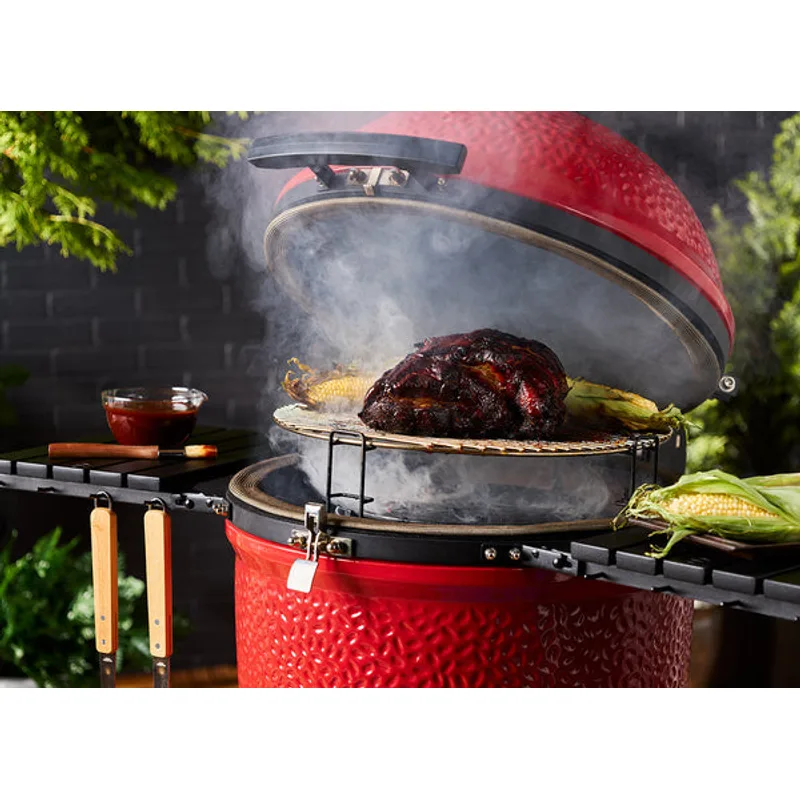
Kamado Joe Classic Joe III 18-Inch Charcoal Grill
The Classic Joe III is the premium choice for cooks who want one outdoor cooker that does everything at the highest level. The 2-inch ceramic walls function as a thermal battery — once at temperature, the ceramic radiates heat evenly from all directions, not just below the grates. That’s why kamado-smoked briskets develop more even bark than offset smoker results, and why kamado pizza cooks more like a wood-fired oven than a standard grill with a stone.
The SloRoller Hyperbolic Smoke Chamber creates a cyclone circulation pattern inside the dome. Owner accounts on grill forums note more smoke ring penetration on briskets compared to flat-lid charcoal configurations.
At $1,550 with the cart, it’s the most expensive grill on this list. The justification is longevity: well-maintained ceramic kamado cookers regularly reach 20-30 year lifespans according to owner communities built around older Big Green Egg and Kamado Joe models. The lifetime ceramic warranty backs that claim.
At 250 lbs assembled, position it on firm, level ground and plan to leave it there.
4. Weber Original Kettle Premium 22” — Best Charcoal Value

Weber Original Kettle Premium Charcoal Grill 22-Inch
The 22-inch Kettle has been the best-selling charcoal grill in the US for decades, and the Premium version adds three meaningful upgrades over the base model: a hinged cooking grate (you can add charcoal without moving food), a built-in thermometer for rough temperature reference, and the One-Touch cleaning system.
At $219, it’s the most affordable path to genuine charcoal flavor. The 363 sq in cooking area fits 13 standard burgers or one spatchcocked chicken with room alongside for sides. For a household of four, that covers most meals.
The 10-year warranty on bowl and lid is noteworthy. Budget charcoal grills from competing brands cover one year; Weber’s 10-year coverage signals confidence in the porcelain-enameled steel.
Cooking on a kettle takes a few sessions to master. Two-zone setup — coals on one side, bare grates on the other — is the core technique: sear directly over the coals, then move food to the indirect side to finish without burning. Once the damper technique clicks, most owners report they have no reason to reach for a gas grill for standard cookouts.
5. Char-Broil Performance Series 4-Burner — Best Budget Gas Grill

The Char-Broil Performance 4-Burner delivers four independently controlled burner zones plus a 10,000 BTU side burner — a feature combination you’d typically pay $150 more for on comparable Weber or Broil King models — all for $247.
The porcelain-coated cast iron grates hold heat adequately and produce usable sear marks. The side burner handles sauce warming, corn boiling, or a cast iron skillet for finishing steaks. Four burners let you run a two-zone cooking setup with additional zones to spare.
The trade-off versus premium grills is material thickness. Owner accounts and verified reviews note surface rust on the exterior after 2-3 seasons without a cover. The burners carry a 5-year warranty, but the overall grill body runs 5-7 years in typical outdoor use. A quality grill cover from day one extends that meaningfully.
For a first gas grill, a rental patio setup, or a secondary grill for overflow cooking at large gatherings, the Char-Broil Performance 4-Burner is the rational choice.
Common Mistakes When Buying a Grill
Buying based on BTU alone. A 60,000 BTU grill on 450 sq in burns more fuel without delivering better sears than a well-designed 39,000 BTU grill on the same surface. Look at BTU per square inch, not the raw total.
Underestimating assembly time. Every grill on this list requires 30 minutes to 2 hours of setup. Plan for it before your first cookout.
Skipping the cover. Painted and powder-coated steel grills rust faster than most buyers expect. A $30-40 cover pays for itself in the first season.
Buying too small. A 300 sq in grill fills up quickly. If you ever cook for more than four people, go up a size. You cannot cook four chicken thighs and corn simultaneously on a compact grill.
Choosing a pellet grill for searing. Pellet grills peak around 450-500°F. If your primary use case is reverse-searing thick steaks or fast-cooking burgers, a gas grill or kamado delivers what a pellet grill cannot.
Leaving pellets in the hopper during rain. Wet pellets swell and jam the auger. Empty the hopper or move the grill under cover before extended wet weather.
FAQ
What type of grill is best for beginners? A gas grill is the most beginner-friendly. Turn the knob, preheat for 10 minutes, cook, turn it off. The Char-Broil Performance 4-Burner at $247 keeps the entry cost reasonable while still delivering reliable four-zone cooking. The Weber Genesis E-325 is worth the extra investment if you plan to grill regularly for years.
How long does a quality grill last? A premium gas grill like the Weber Genesis, maintained with a cover and annual cleaning, is built for 10-15 years. Ceramic kamados regularly exceed 20-30 years. Pellet grills have more electronics and moving parts; owners typically see 7-10 years. Budget gas grills in the $200-$300 range tend to run 5-7 years.
Can you smoke on a gas grill? Yes, with a smoker box. Fill a cast iron or stainless smoker box with wood chips, place it directly over a burner on high heat until it starts smoking, then reduce that burner to low and cook indirectly. The result is lighter smoke flavor than a dedicated smoker, but noticeably different from plain gas grilling.
Is a pellet grill worth the extra cost over charcoal? If you regularly cook briskets, ribs, and pork shoulders and prefer set-it-and-forget-it convenience, a pellet grill justifies the cost. If you mostly grill burgers and chicken, the Weber Kettle at $219 delivers comparable flavor at a fraction of the price.
When is the best time to buy a grill? Late summer and fall bring the deepest discounts as retailers clear inventory before winter. Labor Day weekend sales routinely knock 20-30% off gas and charcoal grills.
What size grill do I need for a family of four? 400-500 sq in of primary cooking area is the practical target for four people with occasional guests. The Weber Kettle at 363 sq in is workable for most meals. The Char-Broil Performance at 475 sq in adds comfortable margin. The Weber Genesis at 513 sq in primary area is more than you need for daily family cooking, but you’ll use the extra space when guests arrive.
Do I need a natural gas conversion for the Weber Genesis E-325? The base model is propane. Weber offers a natural gas version and a conversion kit separately. If you have a natural gas line at your patio, confirm the right model or kit before ordering.
The Bottom Line
For most backyards, the Weber Genesis E-325 is the right gas grill — cast-aluminum firebox, even heat, and a 10-year warranty make it a buy-once decision at $949. If budget is the priority, the Char-Broil Performance 4-Burner delivers four-zone gas grilling with a side burner for $247. For smoking and long cooks, the Traeger Westwood at $699 is the strongest value in pellet grills. And if you want one outdoor cooker that smokes, roasts, and sears at high heat, the Kamado Joe Classic III at $1,550 is built for decades of use.