Propane fire pits have become the go-to choice for homeowners who want instant flames without the smoke, ash cleanup, or fire code restrictions that come with wood-burning options. After researching dozens of models and comparing heat output specifications, we’ve identified the best propane fire pits for every scenario — from portable camping units to permanent patio centerpieces.
Our top pick: The Outland Living Firebowl 893 delivers 58,000 BTU of clean-burning heat, sets up in minutes, and includes everything you need to start using it tonight. At around $165, it’s the most capable fire pit per dollar we’ve found.
If you want something that doubles as patio furniture, the BALI OUTDOORS Fire Pit Table hides the propane tank inside a stylish steel base and adds genuine table surface around the flame — all for under $400.
Quick Picks
| Category | Our Pick | Price | Why We Chose It |
|---|---|---|---|
| Best Overall | Outland Living Firebowl 893 | Check price | Highest BTU output, most complete accessory kit, fastest setup |
| Best Value | BALI OUTDOORS Fire Pit Table | Check price | Hidden tank, table functionality, pulse ignition — all under $400 |
| Best Portable | Heininger 5995 | Check price | Lightest at 20 lbs, works with camping canisters, travels easily |
| Best Table Design | Mazatzal 42” Fire Pit Table | Unavailable | Full patio table with concealed tank and 50,000 BTU output |
Comparison Table
| Fire Pit | BTU Output | Weight | Tank Hidden | Table Surface | Price Range |
|---|---|---|---|---|---|
| Outland Living Firebowl 893 | 58,000 | 25 lbs | No | No | Check price |
| Mazatzal 42” Fire Pit Table | 50,000 | 82 lbs | Yes | Yes | Unavailable |
| Camp Chef Redwood | 55,000 | 32 lbs | No | No | Unavailable |
| Heininger 5995 | 58,500 | 20 lbs | No | No | Check price |
| BALI OUTDOORS Table | 50,000 | 77.5 lbs | Yes | Yes | Check price |
Detailed Reviews
1. Outland Living Firebowl 893 — Best Overall
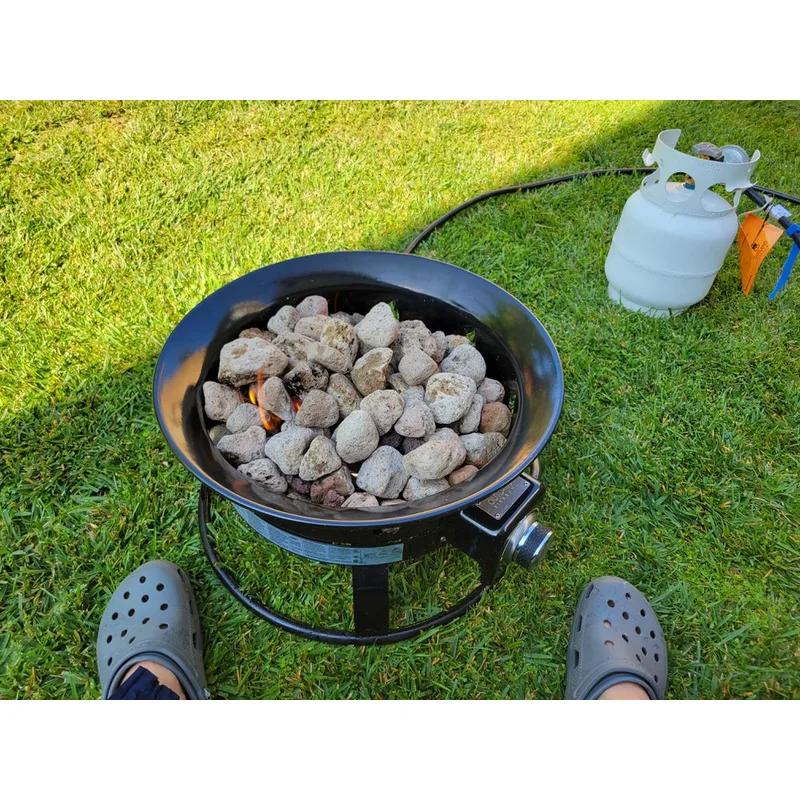
Rating: 9.4/10 | ~$165
The Outland Firebowl 893 has dominated the portable propane fire pit market for years, and the 2026 version maintains that lead. At 58,000 BTU, it produces more heat than most competitors twice its price. You’ll feel genuine warmth sitting 10–12 feet away, which transforms cool evening gatherings into comfortable extended hangouts.
Setup takes under five minutes. Connect the included 10-foot hose to a standard 20-lb propane tank, twist the igniter, and you’re lit. The CSA certification means the safety systems have been independently verified — the flame guard prevents direct contact, and the automatic shutoff triggers if the unit tips or the flame extinguishes unexpectedly.
What’s included matters at this price point, and Outland delivers: a weather-resistant cover, carrying strap for transport, pre-attached regulator, and the full 10-foot hose that lets you position the fire pit well away from the tank. Many competitors charge $30–$50 extra for these accessories.
The compromises are predictable for a portable unit. The propane tank sits visibly beside the fire pit rather than concealed inside a base. There’s no table surface around the flame — it’s a bowl, not furniture. The optional wind guard (sold separately for about $30) is worth buying if you live in a breezy area.
Who should buy this: Anyone who wants maximum heat output and portability without overspending. Perfect for renters, camping trips, or homeowners who want to try propane fire pits before committing to a built-in installation.
Who should skip this: If the visible propane tank bothers you aesthetically, or if you need table space around the flame, look at the table-style options below.
2. Mazatzal 42” Square Fire Pit Table — Best Table Design

Rating: 9.0/10 | ~$500
This fire pit transforms from flame to functional patio furniture and back. The 42-inch square design seats six comfortably around the perimeter, and when the flame is off, the included lid converts the center to a flat table surface. That dual-use justifies the higher price for patios where space matters.
A pull-out shelf inside the base conceals the 20-lb propane tank, accessed from the side. No ugly tank sitting next to your furniture. The adjustable flame control lets you dial from full 50,000 BTU heat down to a decorative low glow that extends tank life significantly.
Assembly is the main drawback. Budget an hour, working through the panel connections carefully. The lightweight aluminum frame makes the parts easier to handle than a comparable steel table, and the finished 82-lb table is still solid enough that you’ll want to pick your spot before final assembly.
The included fire glass adds visual appeal over traditional lava rocks. The all-weather gray rattan wicker finish over the aluminum frame complements most patio furniture styles, though it works best with traditional or transitional outdoor decor rather than ultra-modern settings.
Who should buy this: Homeowners who want a permanent patio centerpiece that functions as both furniture and fire pit. Great for entertaining and formal outdoor spaces.
Who should skip this: Anyone who needs portability, rents their home, or wants to avoid assembly projects.
3. Camp Chef Redwood — Solid Compact Option

Rating: 8.8/10 | ~$165
The Camp Chef Redwood is a compact 19-inch propane fire pit that splits the difference between the Outland’s bare-bones bowl and the heavier table-style units above. At 32 lbs, it’s light enough to load into a car trunk, and the included carry bag and roasting sticks make it just as at home at a tailgate or campsite as it is on a patio.
The 55,000 BTU output puts it solidly in the “actually produces heat” category rather than the “decorative flame” tier. Matchless ignition means no fumbling with lighters in the wind — turn the knob and the flame catches reliably. The nickel-coated steel safety ring, cut with a decorative pine-tree pattern, resists rust better than plain painted steel.
Lava rocks come included, which spread heat more evenly than open flames. Some owners switch to fire glass for aesthetics, though lava rocks perform better for pure warmth distribution. The pre-attached hose and regulator connect to a standard 20-lb tank the same way the Outland does.
The main tradeoff is versatility: there’s no lid or table surface here, so the top stays a fire bowl whether the flame is on or off. Some owners also report the lava rocks shed fine dust when you first pour them in — a quick rinse solves it.
Who should buy this: Buyers who want more heat output than the Heininger in a still-portable package, without paying table-style prices. Good middle-ground option for campers and tailgaters.
Who should skip this: If you want a flat table surface when the flame is off, look at the Mazatzal or BALI OUTDOORS fire pit tables above instead.
4. Heininger 5995 — Best Portable
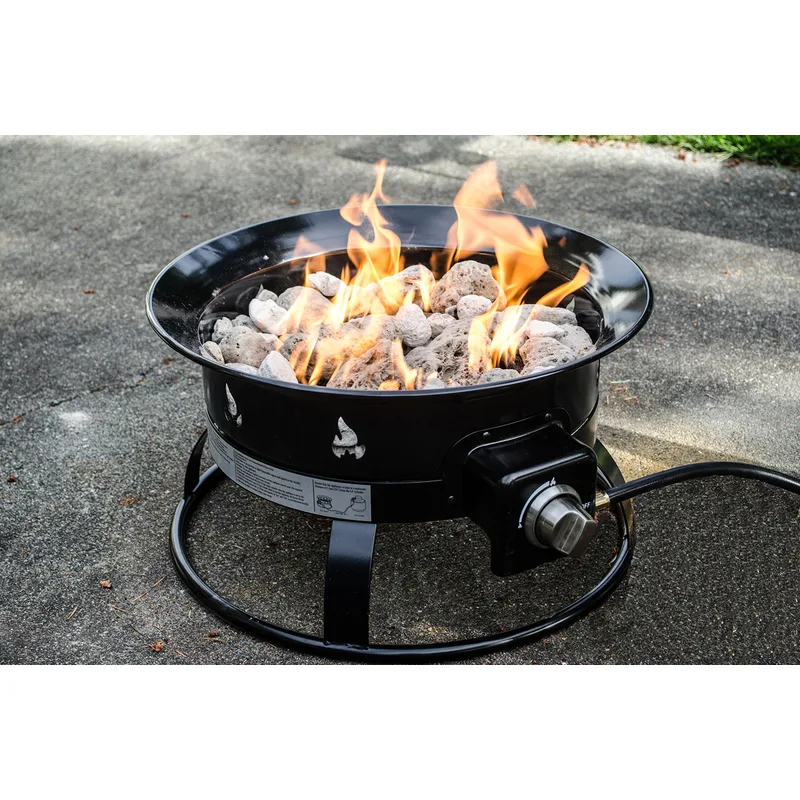
Rating: 8.6/10 | ~$130
At 20 pounds, the Heininger 5995 is the lightest full-size propane fire pit in this comparison. That matters enormously if you’re carrying it to campsites, tailgates, or beach bonfires. The compact 18.5-inch diameter fits in most car trunks without rearranging gear.
Fuel flexibility sets the Heininger apart. It works with standard 20-lb propane tanks via the included 10-foot hose, but also connects directly to 1-lb camping canisters with an adapter (included). Those small canisters run about 2–3 hours, perfect for a single evening without hauling a heavy tank.
Despite its size, the 58,500 BTU output matches or exceeds larger competitors. The flame pattern spreads heat effectively in a 360-degree radius, making it genuinely functional for warming a circle of chairs rather than just providing ambiance.
The trade-offs are predictable: no table surface, no concealed tank storage, and no carrying case included (the steel bowl travels in a box or wrapped in a blanket). A spark screen is available separately but not necessary for normal use — propane doesn’t produce the flying embers that wood fires do.
Who should buy this: Campers, tailgaters, and anyone who needs to transport their fire pit regularly. Also ideal for apartment dwellers with small balconies (check your building’s rules first).
Who should skip this: If portability isn’t a priority, the Outland Firebowl offers a more complete package for about $30 more.
5. BALI OUTDOORS Fire Pit Table — Best Value

Rating: 9.2/10 | ~$350
The BALI OUTDOORS delivers fire pit table features — hidden tank, adjustable ignition, a functional lid, glass rocks — at a price usually reserved for basic bowl designs. Under $400, you get a legitimate patio centerpiece that looks far more expensive than it is.
The stamped-steel base, finished in a wicker-look pattern, conceals a standard 20-lb propane tank completely. A side opening provides easy access for tank changes, and the internal space is sized correctly — you won’t struggle to fit the tank or connect the hose.
The rectangular 42” x 25” design works better for some patio layouts than square alternatives. It fits naturally against a wall or between two sofas. The ceramic tile tabletop around the fire area provides genuine table functionality for drinks and plates, though it’s not as heat-resistant as stone alternatives — use coasters and trivets.
Flame adjustment runs smoothly from full 50,000 BTU heat down to a low decorative flicker. The pulse ignition system lights the burner with a simple turn of the control knob and works reliably even in light wind. Fire glass rocks are included, pre-cleaned and ready to pour into the burner pan.
Who should buy this: Budget-conscious homeowners who want table-style features without the $600+ price tag. A strong choice for covered patios and moderate climates.
Who should skip this: If you need a round table design for your seating arrangement, or want a tabletop that doubles as a heat-safe cooking surface.
Propane Fire Pit Buying Guide
BTU Output: How Much Heat Do You Actually Need?
BTU (British Thermal Units) measures heat output, but bigger numbers don’t always mean better performance. Here’s what the ranges actually mean:
- 30,000–40,000 BTU: Decorative ambiance. Looks nice but won’t keep you warm past arm’s length on cool nights. Fine for mild climates.
- 40,000–50,000 BTU: Functional warmth. Comfortable seating zone extends 6–8 feet from the flame. Adequate for most backyard use.
- 50,000–60,000 BTU: Serious heat. Feel warmth at 10–15 feet. Extends your outdoor season into cooler months.
- 60,000+ BTU: Commercial-grade output. Typically overkill for residential use and burns through propane faster.
All five of our picks fall in the 50,000–60,000 BTU range, which we consider the sweet spot for genuine usefulness without excessive fuel consumption.
Portability vs. Permanence
Decide this before shopping. The two categories require fundamentally different products:
Portable fire pits (Outland Firebowl, Heininger, Camp Chef):
- Weigh 20–35 lbs
- Set up in minutes
- Tank sits outside the unit
- No assembly required
- Lower price points ($125–$200)
- Can travel to campsites, tailgates, vacation homes
Fire pit tables (BALI OUTDOORS, Mazatzal):
- Weigh 75–90+ lbs
- Require about an hour of assembly
- Conceal the tank inside the base
- Function as patio furniture when flame is off
- Higher price points ($300–$550+)
- Essentially permanent once placed
There’s no hybrid that does both well. Portable units like the Camp Chef Redwood stay a fire bowl whether the flame is on or off — if you want table functionality, you need to commit to one of the table-style picks above.
Safety Features to Require
Propane fire pits are generally safer than wood-burning alternatives — no embers, no ash, instant off-switch — but some features matter:
CSA or UL certification: Third-party safety certification. All our picks carry CSA certification. Avoid unbranded imports without certification marks.
Auto-shutoff: Cuts propane flow if the flame goes out unexpectedly. Prevents gas accumulation. Standard on quality units.
Tip-over protection: Shuts down if the unit falls over. Critical for portable models.
Flame guard/wind guard: Physical barrier preventing direct contact with flame. Some are included, others sold separately.
Thermocouple: Detects whether the flame is actually lit before allowing gas flow. Present on all certified units.
Tank Size and Runtime
Standard 20-lb propane tanks run approximately:
- 4–6 hours at maximum output (50,000+ BTU)
- 8–12 hours at medium flame
- 15–20 hours at decorative low setting
A 20-lb tank costs $15–$25 to refill at most hardware stores, making operating costs roughly $3–$6 per evening at full heat. Tank exchange programs (Blue Rhino, AmeriGas) run slightly more but offer convenience at big-box retailers.
For camping, 1-lb canisters work with the Heininger and some Outland models via adapters. Expect 2–3 hours of runtime per canister at medium flame.
Installation and Placement
Distance requirements: Keep propane fire pits at least 10 feet from structures, overhangs, and combustible materials. Check local fire codes — some jurisdictions have stricter requirements.
Surface: Use on non-combustible surfaces (concrete, pavers, gravel) or fire-rated pads on wood decks. Composite decking can warp under high heat.
Ventilation: Outdoor use only. Propane combustion produces carbon monoxide — never use in enclosed spaces, including screened porches and gazebos with poor airflow.
Wind: Position away from prevailing wind direction, or add a wind guard. High winds can blow flames unpredictably and increase propane consumption.
Frequently Asked Questions
Can I use a propane fire pit on a wood deck?
Yes, with precautions. Place a fire-rated mat or heat shield (available for $30–$50) under the unit. The bottom of most propane fire pits doesn’t get dangerously hot, but radiated heat can damage deck surfaces over time. Composite decking is more vulnerable than treated wood. Fire pit tables with enclosed bases pose less risk than bowl-style units with open flames closer to the deck surface.
How long does a propane tank last in a fire pit?
A standard 20-lb tank lasts 4–6 hours at full flame (50,000+ BTU) or up to 20 hours at low decorative settings. Real-world usage typically falls in between — most evenings you’ll run at medium flame for 2–3 hours, getting 8–10 evenings per tank. Refills cost $15–$25 at hardware stores or propane suppliers.
Are propane fire pits legal in fire-restricted areas?
Usually yes. Most fire bans target open wood burning due to ember and smoke risks. Propane fire pits with CSA/UL certification and auto-shutoff features are typically permitted during fire season restrictions. However, rules vary by jurisdiction — verify with your local fire department before purchasing, especially if you live in high-fire-risk areas like California or Colorado.
Do propane fire pits produce smoke?
Virtually none. Propane combustion produces water vapor and CO2 but no smoke, ash, or particulates. This is a major advantage for neighbors, allergies, and clothing (no campfire smell). However, burning debris in the fire pit — leaves, paper, marshmallow drippings — will produce smoke. Keep the burner clean for smoke-free operation.
What’s the difference between lava rocks and fire glass?
Lava rocks: Better heat distribution, more natural appearance, less expensive. The porous surface absorbs and radiates heat evenly. Requires occasional replacement as rocks crack over time.
Fire glass: More decorative, reflects light beautifully, easier to clean. Tempered glass doesn’t crack or degrade. However, it doesn’t distribute heat as effectively as lava rocks. Costs 2–3x more for equivalent coverage.
Both work in any propane fire pit. Many owners start with included lava rocks and upgrade to fire glass later for aesthetics.
Can I convert a propane fire pit to natural gas?
Most models offer conversion kits ($30–$80), but check manufacturer compatibility before purchasing. Natural gas conversion requires a professional gas line installation ($300–$800 depending on distance from main line), but eliminates tank refills and storage. Only worth considering for permanent installations where you’re certain the fire pit won’t move.
How do I winterize a propane fire pit?
Disconnect the tank and store it upright in a ventilated area (not indoors). Cover the fire pit with a weather-resistant cover or store it in a garage/shed. Remove glass or lava rocks if storing outdoors to prevent moisture damage. For fire pit tables, ensure drainage holes aren’t blocked — trapped water can crack tanks during freezing.
The Verdict
For most buyers, the Outland Living Firebowl 893 at around $165 is the right choice. It delivers the highest heat output in this roundup (58,000 BTU), includes all necessary accessories, and works equally well on patios, at campsites, or on tailgate trips. The visible propane tank is the only real drawback — if that bothers you aesthetically, spend more on a table-style unit.
The BALI OUTDOORS Fire Pit Table offers the best value if you want furniture-grade appearance with a hidden tank. Under $400 for this level of finish and functionality is genuinely competitive with units costing $200 more.
For maximum portability, the Heininger 5995 at $130 weighs just 20 lbs and works with both standard tanks and camping canisters — unmatched flexibility for travelers.
Whatever you choose, propane fire pits transform cool-weather outdoor time from “tolerable” to “genuinely comfortable.” The investment pays off in extended patio season, smokeless evening gatherings, and the convenience of instant on/off control. No more babysitting dying embers or dealing with next-morning ash cleanup.
Last updated: July 2026. Prices fluctuate on Amazon — we update this guide quarterly to reflect current availability and pricing.