You have decided on Weber. Smart choice. Now comes the harder question: Spirit or Genesis?
The short answer: The Weber Genesis E-325s is the better grill for serious cooks who entertain regularly and want a sear station. The Weber Spirit II E-310 is the smarter buy for smaller families, tighter budgets, and limited patio space. Both grills share Weber’s excellent build quality and will last 10-15 years with basic maintenance.
The price gap between these two grills is roughly $500. This guide breaks down exactly what that extra money buys you and whether it is worth it for your specific situation.
Quick Specs Comparison
| Feature | Weber Spirit II E-310 | Weber Genesis E-325s |
|---|---|---|
| Price | $499 | $999 |
| Total Cooking Area | 529 sq in | 787 sq in (includes warming rack) |
| Primary Cooking Area | 424 sq in | 513 sq in |
| BTUs (Main Burners) | 30,000 | 39,000 |
| Sear Station | No | Yes (9,000 BTU) |
| Number of Burners | 3 | 3 + Sear Zone |
| Grate Material | Porcelain-enameled steel | Stainless steel |
| Side Tables | 2 folding | 2 fixed |
| Warming Rack | Yes | Yes, larger |
| Built-in Thermometer | Yes | Yes |
| iGrill Compatible | Yes | Yes |
| Dimensions (Lid Open) | 63” H x 50” W x 32” D | 71” H x 59” W x 29” D |
| Weight | 114 lbs | 157 lbs |
| Warranty | 10 years | 10 years |
Build Quality: Both Are Solid, But Genesis Feels Premium
Weber does not make cheap grills. Even the Spirit line uses heavier gauge steel than most competitors at double the price. That said, you can feel the difference when you lift the Genesis lid versus the Spirit lid. The Genesis uses thicker materials throughout, from the firebox to the frame to the lid handle.
Spirit II E-310 Build
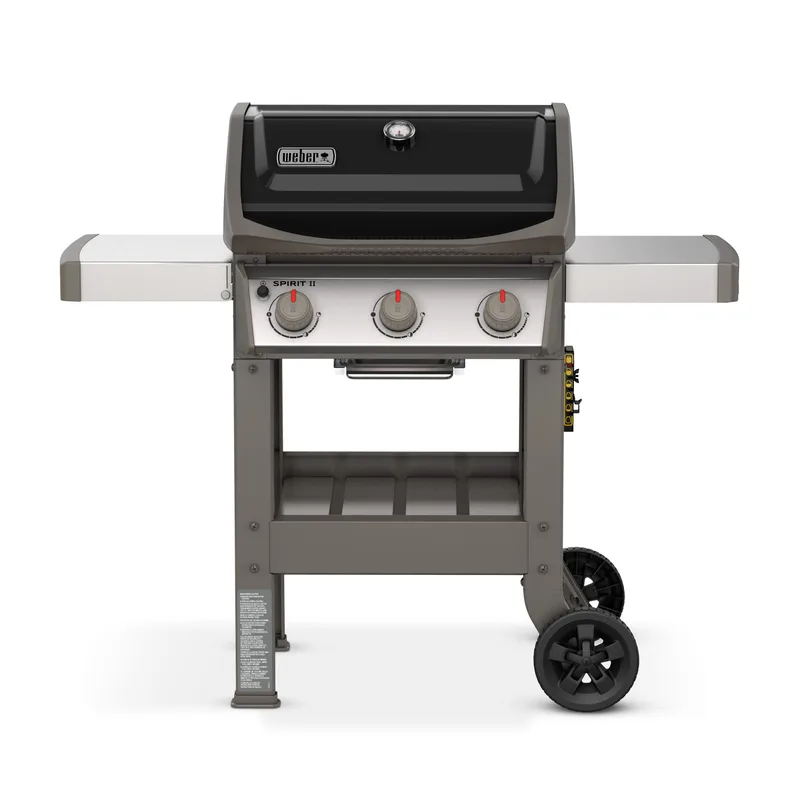
The Spirit II uses porcelain-enameled steel for the cook box and lid. This finish resists rust well and looks good for years, though it can chip if you are rough with your grill tools. The stamped steel frame is sturdy but not overbuilt. Side tables fold down for storage, which is convenient for tight spaces but means slightly less stability when you are actually using them.
The GS4 grilling system includes Weber’s Infinity ignition, which reliably lights every time. Flavorizer bars sit below the grates and above the burners, catching drippings and vaporizing them back up for that classic grill flavor. The grease management system funnels everything into a drip tray that slides out from the front.
Assembly takes about 90 minutes for most people. The instructions are clear and all the parts fit together without forcing.
Genesis E-325s Build
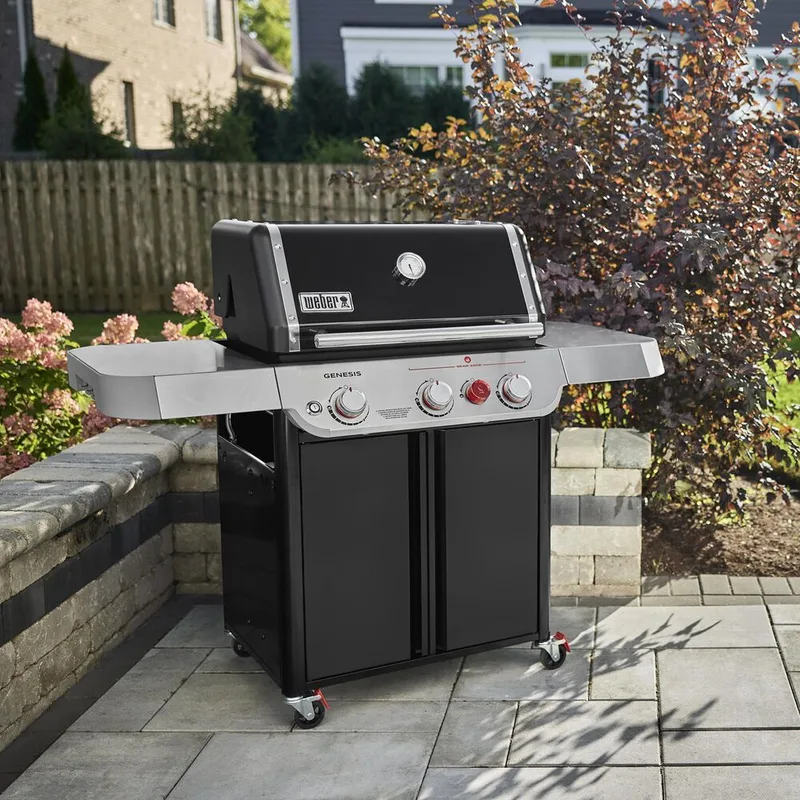
The Genesis steps up in almost every material category. The cook box uses thicker porcelain-enameled steel. The grates are stainless steel rather than porcelain-enameled, which means better heat retention and easier cleaning over time. Fixed side tables feel more substantial and can handle heavier loads without wobbling.
The Genesis uses the same GS4 grilling system but adds the Sear Station, a dedicated high-heat zone between the main burners that puts out 9,000 BTUs in a concentrated area. This is the Genesis’s signature feature and the biggest functional difference between the two lines.
Weber also includes more thoughtful details on the Genesis: built-in tool hooks, a larger warming rack, and an enclosed cabinet that hides the propane tank while providing storage space.
Assembly runs about two hours. More parts, more fasteners, but the same clear Weber instructions.
The Verdict on Build Quality
Both grills will last a decade or more with minimal care. The Genesis feels like a piece of outdoor furniture you are investing in. The Spirit feels like a well-made appliance. Neither will disappoint you, but if you care about the heft and substance of your grill, the Genesis delivers more of it.
Cooking Performance: The Sear Station Makes a Real Difference
This is where your cooking style determines which grill makes sense.
Heat Output and Distribution
The Spirit II E-310 puts out 30,000 BTUs across three burners, roughly 10,000 BTUs per burner. That is plenty for standard grilling: burgers, hot dogs, chicken breasts, vegetables. The grill reaches 500-550 degrees Fahrenheit with the lid closed, which handles most backyard cooking tasks.
The Genesis E-325s delivers 39,000 BTUs from its main burners, plus another 9,000 from the dedicated Sear Station. That extra heat translates to faster preheating, better recovery after opening the lid, and the ability to sear steaks at temperatures the Spirit cannot match.
The Sear Station Explained
Weber’s Sear Station concentrates high heat in a small zone, pushing surface temperatures past 700 degrees Fahrenheit. This matters for one specific cooking technique: getting a hard sear on the outside of meat while keeping the inside rare or medium-rare.
Without a sear station, getting proper Maillard reaction on a steak requires workarounds: preheating longer, keeping the lid closed more, or accepting a less defined crust. The Genesis eliminates the workaround. You preheat your main burners, sear the steak over the Sear Station for 60-90 seconds per side, then move it to a cooler zone to finish.
If you mostly cook burgers, brats, and chicken, you will not miss the Sear Station. If you regularly cook steaks, lamb chops, or want to char vegetables with restaurant-level heat, it is a genuine upgrade.
Cooking Space
The Spirit II’s 424 square inches of primary cooking space handles about 15 burgers at once. That is enough for a family of four with occasional company, but larger gatherings require cooking in batches.
The Genesis E-325s offers 513 square inches of primary space, plus a more substantial warming rack. You can comfortably grill for 8-10 people without batching, or keep finished food warm while the next round cooks.
Temperature Control
Both grills use individual burner controls for zone cooking. You can run one burner on high, one on medium, and leave one off for indirect heat. The Spirit’s knobs are basic but functional. The Genesis adds clearer markings and slightly smoother adjustment.
Neither grill has smart temperature control built in. Both are iGrill 3 compatible, meaning you can add Weber’s Bluetooth thermometer to monitor meat temperatures from your phone. The iGrill is sold separately for around $100.
Performance Verdict
For everyday grilling, both perform excellently. The Genesis earns its premium if you regularly sear steaks at high heat or need to cook for larger groups. If your typical cookout is burgers and chicken for four people, the Spirit handles the job and saves you $580.
Features: What the Extra Money Actually Buys
Beyond the Sear Station and larger cooking surface, here is what the Genesis adds:
Stainless Steel vs Porcelain-Enameled Grates
The Spirit’s porcelain-enameled steel grates work fine but have limitations. The coating can chip over time, especially if you use metal scrapers or drop heavy grates during cleaning. Once chipped, rust can start underneath the enamel.
Genesis stainless steel grates resist corrosion without any coating to chip. They also retain heat better, giving you more pronounced grill marks. The downside: stainless requires seasoning to build up a non-stick patina, and food may stick more during the first few months of use.
Storage and Organization
The Genesis includes an enclosed cabinet that hides your propane tank and provides shelf space for tools, rubs, and accessories. Built-in hooks on the front hold your spatula, tongs, and brush. An integrated paper towel holder sits on one side table.
The Spirit has open storage below, which some people actually prefer for airflow and quick tank access. There are no built-in hooks, but Weber sells a tool holder accessory that clips onto the side tables.
Side Table Design
Spirit side tables fold down for compact storage. This is practical if you need to squeeze the grill against a wall or through a narrow gate. The trade-off is less stability when the tables are deployed and under load.
Genesis side tables are fixed in place. More solid, more usable workspace, but the grill always takes up its full footprint.
Lighting and Visibility
The Genesis E-325s includes better visibility features: a larger lid-mounted thermometer and slightly better positioning for monitoring without opening the lid. Neither grill has built-in grill lights, though Weber sells a handle-mounted light accessory that fits both.
iGrill 3 Integration
Both grills have a dedicated mount point and power connection for the iGrill 3 smart thermometer. The iGrill lets you monitor up to four probe temperatures from your phone via Bluetooth. It is a useful accessory for low-and-slow cooking or getting steaks to exact temperatures, but it is not included with either grill.
Value Analysis: When to Spend More, When to Save
The Spirit II E-310 costs $499. The Genesis E-325s costs $999. That $500 gap buys you:
- Sear Station (9,000 BTU dedicated high-heat zone)
- 89 more square inches of primary cooking area
- Stainless steel grates instead of porcelain-enameled
- 9,000 more BTUs of total heat
- Fixed side tables with better stability
- Enclosed storage cabinet with hooks
- Larger overall build with more substantial materials
Buy the Spirit II E-310 If:
-
Your budget matters. $499 is a lot of grill for the money. The Spirit outperforms most competitors at its price point and plenty of grills that cost more.
-
You have limited space. The Spirit’s smaller footprint and folding side tables fit balconies, small patios, and tight deck corners where the Genesis would dominate.
-
You cook for four or fewer regularly. A family that grills burgers and chicken on weeknights will never hit the Spirit’s limits.
-
Searing is not your priority. If you rarely cook steaks, or you are fine with good-enough sear marks rather than steakhouse-quality crust, you will not miss the Sear Station.
-
You want Weber quality without Weber flagship pricing. The Spirit gives you the same warranty, the same GS4 system, and the same durability, just in a smaller package.
Buy the Genesis E-325s If:
-
You entertain regularly. Cooking for 8-10 people without batching is a real quality-of-life upgrade for anyone who hosts frequently.
-
Searing matters to you. The Sear Station is not a gimmick. If you love a hard crust on your ribeye, this is the feature that justifies the price increase.
-
You view the grill as a long-term investment. Spread over 15 years of use, the Genesis costs about $33 per year more than the Spirit. The stainless grates and thicker construction may pay back that difference in durability.
-
You want the complete outdoor kitchen experience. The Genesis looks and feels like serious equipment. If your backyard setup is important to you, the Genesis anchors it better than the Spirit.
-
You have the space and budget. Do not buy the Genesis just because it is the better grill. Buy it because you will use the features that make it better.
Weber Spirit II E-310: Full Breakdown
Weber Spirit II E-310
Rating: 8.4/10 | Best Value | $499
The Spirit II E-310 represents Weber’s entry into serious grilling. Do not let the word entry mislead you. This is a 114-pound grill with three burners, 529 total square inches of cooking space, and the same 10-year warranty Weber puts on grills costing twice as much.
The GS4 grilling system works exactly as advertised. The Infinity ignition lights every burner, every time, without the click-click-click frustration common on cheaper grills. Flavorizer bars catch drippings and vaporize them, adding smoky flavor without flare-ups. The grease management system keeps the firebox clean and directs grease into a removable tray.
Cooking performance handles the backyard basics excellently. Three independent burner controls give you zone cooking for indirect heat. The grill reaches 500 degrees Fahrenheit or higher within 10-15 minutes. Heat distribution across the grates is even enough that you do not need to rotate food constantly.
The porcelain-enameled grates are the main compromise at this price point. They work well but require more careful maintenance than stainless steel. Use nylon brushes rather than metal scrapers, and address any chips before rust spreads.
Side tables fold down, which is either a feature or a compromise depending on your space constraints. For small patios, the ability to reduce the footprint is genuinely useful. For larger spaces, fixed tables would be preferable.
Who should buy this grill: Families of 2-4 who grill regularly but do not host large gatherings. Budget-conscious buyers who want Weber quality without flagship pricing. Anyone with space constraints who needs a capable grill in a compact form factor.
Who should skip this grill: Frequent entertainers, serious steak enthusiasts, or anyone who will feel limited by 424 square inches of cooking space within a year.
Weber Genesis E-325s: Full Breakdown
Weber Genesis E-325s
Rating: 9.2/10 | Best Overall | $999
The Genesis E-325s is Weber’s do-everything grill for serious home cooks. Three main burners produce 39,000 BTUs, the Sear Station adds another 9,000 concentrated BTUs, and 787 total square inches handle cooking for crowds without breaking a sweat.
The Sear Station is the headline feature, and it delivers. Temperatures in the sear zone exceed 700 degrees Fahrenheit, hot enough to create restaurant-quality crust on steaks in 60-90 seconds per side. Once you get used to having this capability, grilling on a standard three-burner feels like a compromise.
Stainless steel cooking grates retain heat better than the Spirit’s porcelain-enameled grates and tolerate more aggressive cleaning. They require some initial seasoning to develop non-stick properties, but after a few months of use, they become nearly as non-stick as the porcelain option while being far more durable.
Build quality throughout is noticeably heavier than the Spirit. The lid feels solid when you lift it. The firebox is thicker gauge steel. Fixed side tables do not wobble under load. The enclosed cabinet hides your propane tank and provides storage for accessories, rubs, and tools.
At 157 pounds assembled, the Genesis is not a grill you casually rearrange. Four casters make it movable, but plan on this grill staying where you put it.
Who should buy this grill: Home cooks who take grilling seriously and host regularly. Steak enthusiasts who want proper searing without workarounds. Anyone who views the grill as outdoor kitchen furniture and wants something that looks and feels substantial.
Who should skip this grill: Budget-conscious buyers who cannot justify the premium. People with small patios who do not have room for a 59-inch wide grill. Casual grillers who mostly cook burgers and hot dogs.
Frequently Asked Questions
How long do Weber Spirit and Genesis grills last?
Both lines are built to last 10-15 years with basic maintenance. Weber’s 10-year warranty covers all components on both grills, which tells you something about their confidence in durability. Keep your grill covered when not in use, clean the grates after each cook, and empty the grease trap regularly. Users who follow these basics routinely report 15+ years of service from both Spirit and Genesis models.
Is the Sear Station worth the extra cost?
If you regularly cook steaks, chops, or other cuts that benefit from high-heat searing, yes. The Sear Station reaches temperatures the standard burners cannot match, and the difference in crust quality is noticeable. If your grilling is mostly burgers, chicken, and vegetables, you will not miss it. The Sear Station alone does not justify the $580 price gap; consider whether the larger cooking area and stainless grates also matter to you.
Can I convert a Weber Spirit or Genesis from propane to natural gas?
Weber sells both grills in propane and natural gas versions, but converting between them is not officially supported. The orifices, regulators, and hoses differ between fuel types. If you want natural gas, buy the natural gas model upfront. Aftermarket conversion kits exist but void your warranty and create safety risks.
Which grill is better for smoking?
Neither the Spirit nor Genesis is a dedicated smoker, but both can handle smoking with workarounds. You need to set up indirect heat using only one burner, add a smoker box with wood chips above a burner, and monitor temperatures carefully. The Genesis’s larger size and higher BTU output give you more room and better temperature stability for smoking. For serious smoking, consider a dedicated smoker or a Weber kettle with smoking accessories.
Are Weber grills worth the premium over cheaper brands?
For most buyers, yes. Weber uses heavier materials, better quality control, and backs everything with a 10-year warranty. Cheaper grills often use thinner steel that rusts within 2-3 years, unreliable ignition systems, and limited warranties that expire before problems appear. Calculated per year of use, a Weber often costs less than a cheap grill you replace twice. That said, a $300 Char-Broil will cook your burgers while you save up for a Weber. It just will not last as long or perform as well.
What is the best Weber grill for a small balcony or patio?
The Spirit II E-210 (two burners) is smaller than the E-310 and fits tighter spaces. If you need three burners but have limited space, the Spirit II E-310 with its folding side tables is your best option. The Genesis line is too large for small balconies. Also check your lease or HOA rules, as some restrict propane grills on balconies.
How often should I replace the Flavorizer bars?
Weber Flavorizer bars typically last 2-5 years depending on use frequency and maintenance. Signs they need replacing: heavy rust that does not brush off, holes or cracks, or bars that have warped significantly. Both Spirit and Genesis use inexpensive replacement Flavorizer bars available directly from Weber and Amazon.
Does the iGrill 3 work with both grills?
Yes. Both the Spirit II E-310 and Genesis E-325s have dedicated iGrill 3 mounting points and power connections. The iGrill 3 is sold separately for around $100 and lets you monitor up to four probe temperatures via Bluetooth on your phone. It is especially useful for larger cuts, smoking, or getting steaks to precise temperatures.
Final Verdict: Which Weber Gas Grill Should You Buy?
The Weber Genesis E-325s is the better grill. The Sear Station delivers genuinely better results on steaks and other high-heat applications. The stainless steel grates outlast porcelain-enameled. The larger cooking area handles entertaining without batching. The build quality feels more substantial throughout.
The Weber Spirit II E-310 is the smarter buy for most households. You get Weber durability, Weber warranty, and Weber cooking performance for $580 less. The Spirit handles weeknight dinners and small gatherings without compromise. Unless you regularly sear steaks or host large groups, the Genesis’s advantages remain theoretical.
Our recommendation: Start with the Spirit. If you outgrow it, you will know within a year, and Weber grills hold resale value well. If the Sear Station and extra space are calling to you now, and you have the budget and patio space, the Genesis will not disappoint.
Both grills will last a decade or more. Both will make better food than the grill you are replacing. The question is not which one is good enough. It is which one matches how you actually cook.