A portable power station in the 1,000Wh class can keep a fridge, a router and your phones going through a day or two of outage, and a 250-300Wh unit keeps lights and phones alive through a long weekend. Which size you need depends on what has to stay on and for how long. This roundup ranks five units against two realistic situations: three days snowed in at a house, and a long night without power in an apartment where all you need is light, a charged phone and a working router.
None of these will run a whole house. A power station is a big, quiet battery with outlets, and the honest job it does is cover the handful of things that matter most when the grid is down. Pick the few loads first, then pick the size. Every spec below comes from the manufacturer listing, and every pick was ranked on those specs and on the volume of owner feedback, not on our own bench work.
Quick Picks
- Best Budget: Jackery Explorer 300. Phones, a router and a lamp through a night in an apartment.
- Editor’s Pick: EcoFlow RIVER 3. The small unit with the higher 550W output and a fast recharge.
- Best Overall: Anker SOLIX C1000. 1,000Wh class from an established brand, with UPS-style behavior.
- Best Value: OUPES Mega 1. Big output and room to expand, from a newer brand.
- Best Premium: BLUETTI AC180. The most stored energy of the five, for a house with a fridge to protect.
What to Know Before Buying
Start with watt-hours, not marketing
Watt-hours (Wh) is the size of the tank. Watts (W) is how fast you can pull from it. Divide the Wh by the watts your devices draw to get a rough run time, then expect less than that in practice because the inverter loses some energy along the way. The wattage is printed on the label of most devices or listed in the manual.
A small load like a phone charger or a router draws a tiny fraction of what a compressor or a heating element does. That is why a 250-300Wh unit stretches across several days of phone and light use, yet would not carry a fridge through a night. If you do the arithmetic for your own devices on a sheet of paper before you shop, you will usually find that you need either the small class or the 1,000Wh class, and very little in between.
Match the unit to the situation
- Four hours stuck in the car or a short blackout: any of these works, and the smallest is plenty.
- A long night in an apartment: lights, phones, a router and maybe a fan. The 250-300Wh class covers it with room to spare.
- Three days snowed in: lights, phones, a router and probably a fridge. That means a 1,000Wh class unit, ideally with a solar panel to refill it. Our guide to solar outdoor lighting is a cheap way to take lighting off the battery altogether.
- A week without power: a single station will not run a house. Plan on shedding loads, keeping the fridge door shut, and recharging by solar or from the wall whenever the grid flickers back.
What the fridge really needs
Ready.gov says the refrigerator will keep food cold for about four hours, and that a full freezer will keep its temperature for about 48 hours, as long as the doors stay closed. That four-hour window is the reason people reach for a power station in the first place: it buys you time to move the fridge onto battery power before anything warms up. Keep the doors shut, and run the fridge from the station rather than opening it repeatedly to check.
Light is cheaper than power
Before you size a battery for lamps, consider lanterns. A few rechargeable units, such as those in our outdoor lanterns roundup, cover lighting for a room without drawing from the station, which leaves the stored energy for the router, the phones and the fridge.
Battery type and warranty
All five use LiFePO4 (lithium iron phosphate) cells, according to the manufacturer listings. That chemistry is the standard in this class and is rated for long cycle life. Read the warranty terms on the brand’s own page before buying, and keep your order confirmation somewhere you can find it offline.
Where to keep it
Store the station indoors, somewhere dry and within the temperature range in the manual, and keep it topped up. A hall closet or a shelf in a pantry works. If you store the rest of your outage kit outside the house, a lockable deck box keeps solar panels, cables and lanterns dry, but keep the battery itself inside, within its rated temperature range.
Medical devices
If someone in the household relies on a CPAP, an oxygen concentrator or another powered medical device, check the wattage in the device manual and ask your supplier about backup power. Do not rely on a general-purpose power station without that confirmation.
Safety and recalls
In 2026 the Consumer Product Safety Commission announced a recall of Goal Zero YETI 3000X power stations over a circuit-board overheating risk. That product is not on this list. Before you buy or use any station, look up the exact model on the CPSC recall page. If you own a recalled unit, follow the manufacturer’s repair instructions.
Power stations burn no fuel, but plenty of households own a gas generator as well. Ready.gov says generators and fuel should always be used outdoors and at least 20 feet away from windows, doors and attached garages. Never run one in a garage, on a closed porch or near a vent. Whatever you own, put a battery-backed carbon monoxide alarm on every level of your home and check the batteries each season.
Detailed Reviews
1. Jackery Explorer 300: Best Budget
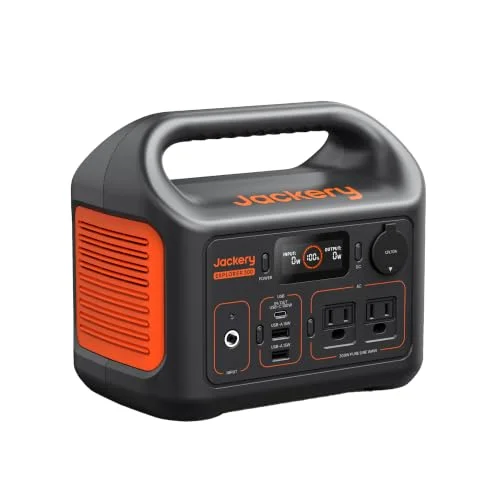
Jackery Explorer 300 is the entry point. At 292Wh with a 300W pure sine wave outlet, it charges phones, a laptop, a router and LED lights. The Amazon listing has thousands of owner reviews, which is the strongest sign that this is a safe, well-understood budget pick, and it is small enough to move from the bedroom to the living room as needed.
Choose it for an apartment, a car kit, or a bedside lamp-and-phone setup. As a rough picture, a 10W router plus a couple of phone charges draws so little that the 292Wh capacity covers a long night with plenty left over. It will not run a space heater or a kettle, and it will not carry a fridge overnight. If your plan is four hours in a stalled car or one dark evening, this is all the battery you need, and the savings are better spent on lanterns and a warm blanket.
2. EcoFlow RIVER 3: Editor’s Pick
EcoFlow RIVER 3 stores less at 245Wh but carries a higher 550W output rating, so it can run slightly more demanding small devices, such as a fan or a small laptop charger brick, without straining. The listing states a one-hour fast charge, which matters when the grid comes back for only a short window between rolling outages.
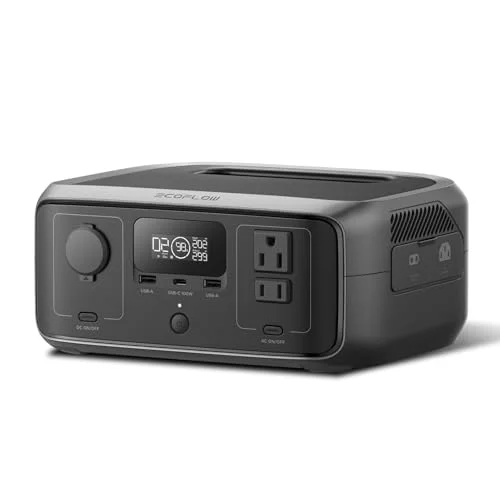
Choose it if you want a small, quick-to-recharge unit and your needs stay in the phones, lights and router category. The trade-off is plain: at 245Wh it is the smallest here, so treat it as a communications-and-light unit. Households with kids tend to care most about the fast recharge, since a dead tablet at hour three of a storm is a bigger problem than a dim kitchen.
3. Anker SOLIX C1000: Best Overall
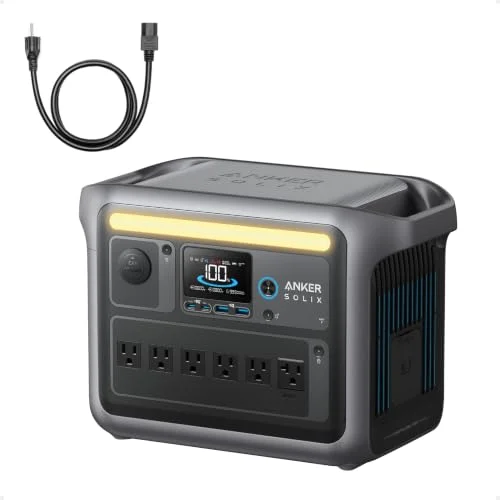
Anker SOLIX C1000 has 1056Wh and an 1800W output (2400W peak), with a listed 58-minute full charge. That combination covers a fridge and a handful of small devices at once, which is the real test for a three-day outage at a house.
It also works as a UPS for a router and computer, so it can sit plugged in and switch over during a flicker. That is useful if anyone works from home, because the video call does not drop when the lights do. It earns Best Overall because the capacity, the output and the established brand support all line up, and because it is easier to buy with confidence than the newer names. Expansion capacity is sold separately, so decide up front whether 1,000Wh is enough.
4. OUPES Mega 1: Best Value
OUPES Mega 1 sits in the same 1,000Wh class (1024Wh) and lists 2000W continuous output with 4500W surge, plus expansion up to 5kWh according to the listing. The 100W USB-C port charges laptops directly, without a brick.
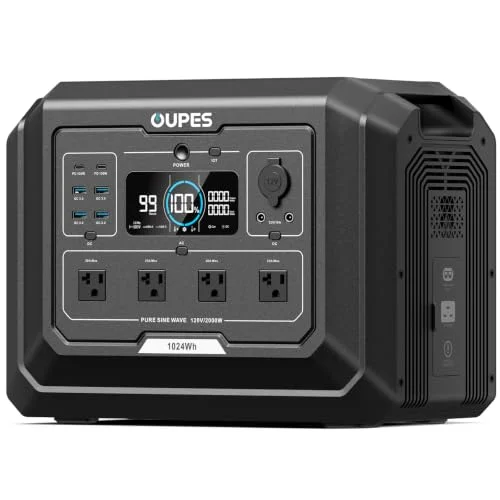
The brand is newer than Jackery or Anker, so read the warranty terms and find out how to reach support before you commit. The expansion option is the reason to pick it over a fixed-capacity unit: you can start with one battery and add capacity later if a longer outage shows you what you were missing. The expansion batteries are additional purchases, and the combined setup is heavy, so plan where it will sit.
5. BLUETTI AC180: Best Premium
BLUETTI AC180 stores 1152Wh and offers two 1800W AC outlets (2700W peak, per the listing). That is enough headroom for a fridge plus a router, a lamp and chargers at the same time. The listing quotes 0-80% in 45 minutes from the wall. The extra money over the small units buys roughly four times the stored energy and enough output to run a fridge and electronics together without choosing between them.
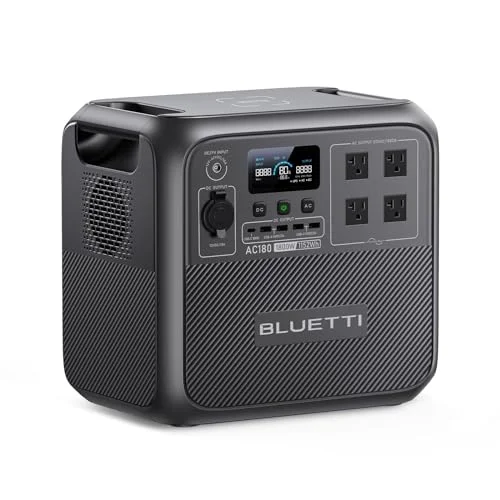
For a three-day snow-in at a house, this is the most stored energy in the list. Add a solar panel if you want to refill it during daylight, and check the panel’s connector and input rating against the station’s spec sheet first. It is heavier than the small units, so give it a permanent spot on a lower shelf near the fridge and a router, with the cords already routed. It will not run electric heat or a well pump for days, and no unit in this class will.
Comparison Table
| Spec | Jackery Explorer 300 Portable Power Station, 292Wh 8.2/10 | EcoFlow RIVER 3 Portable Power Station, 245Wh 8/10 | Anker SOLIX C1000 Portable Power Station, 1056Wh 9/10 | OUPES Mega 1 Portable Power Station, 1024Wh 8.3/10 | BLUETTI AC180 Portable Power Station, 1152Wh 8.8/10 |
|---|---|---|---|---|---|
| Capacity | 292Wh | 245Wh | 1056Wh | 1024Wh | 1152Wh |
| AC output | 300W | 550W | 1800W (2400W peak) | 2000W (4500W surge) | 1800W (2700W peak) |
| Chemistry | LiFePO4 | LiFePO4 | LiFePO4 | LiFePO4 | LiFePO4 |
| Solar | Panel optional | — | — | — | — |
| Rating | 8.2/10 | 8/10 | 9/10 | 8.3/10 | 8.8/10 |
Prices change daily — tap Check Price for the current Amazon price.
Prices change daily — tap Check Price for the current Amazon price.
FAQ
How long will a portable power station run a fridge?
It depends on the fridge. Divide the station’s watt-hours by the fridge’s running watts (on its label) and assume less than the result, because the compressor cycles on and off and the inverter loses some energy. A 1,000Wh class unit can cover part of a day to a day for many fridges, while a 250-300Wh unit cannot. Keep the door shut as much as possible.
Can I run a space heater on a power station?
Not on the small units, and we do not recommend it on any of these. Heating draws far more than the batteries can sustain. Use warm layers and a rated sleeping bag. If you want heat, use only a heater rated for indoor use, following its label, and keep a battery-backed carbon monoxide alarm on every level.
Can I use a power station indoors?
Power stations have no exhaust, and the manufacturers’ manuals describe where to place them, including ventilation clearance and keeping them dry and away from heat. Follow the manual. Gas generators are different: those run outdoors only, never in a garage or near windows.
Do I need a solar panel?
Not for a short outage. For three days or more, a panel lets you refill during daylight. Check the panel’s connector and input rating against the station’s spec sheet, and remember that overcast winter days produce much less than a clear summer day.
What about powering a CPAP or oxygen concentrator?
Check the wattage in the device manual and ask your supplier about backup power. Do not assume a general power station fits.
Should I keep it fully charged?
Yes. Top it off before storm season and follow the manufacturer’s storage guidance for charging it periodically. Put a reminder on your calendar when you change the batteries in your smoke and carbon monoxide alarms.
Is a power station better than a generator?
They solve different problems. A station is silent, has no fumes and can sit in the house, but it holds a fixed amount of energy. A generator can run longer on fuel but must be kept outdoors and away from the house at all times. Many households in a long-outage area keep a small station for the essentials and decide separately about a generator.
The Bottom Line
For one apartment and a long night, the Jackery Explorer 300 is the budget pick and the EcoFlow RIVER 3 is the quicker-charging alternative. For a house with a fridge to protect, the Anker SOLIX C1000 is our Best Overall for its balance of capacity, output and brand support, the OUPES Mega 1 is the value pick if you want room to grow, and the BLUETTI AC180 is the premium choice for the most stored energy of the five. Whichever size you choose, charge it before the season starts, write down the wattage of the few things it must run, and keep a battery-backed carbon monoxide alarm on every level of the house.