Cell towers run on backup batteries, and an outage that lasts a few days can leave a phone with no signal just when a storm warning matters most. A NOAA weather radio does not need the internet or a cell tower. The simple answer: for a house, put a SAME alert radio such as the Midland WR120B by the bed, and keep a crank/solar radio like the FosPower A1 in the outage bin for the days after the storm.
This guide is written around a few real situations: a tornado watch at 2 a.m., a week without power after an ice storm, or three days snowed in with a dead phone. Each radio below is matched to one of those, based on manufacturer specs and Amazon listing details rather than lab numbers.
Quick Picks
- Best Overall: Midland WR120B. A county-filtered desktop alert radio that switches to AA batteries when the power fails.
- Best Budget: FosPower A1. Crank, solar and AAA power in a portable radio with a flashlight and a phone-charging power bank.
- Best Premium: Midland WR400 Deluxe. The extra money buys 25 programmable counties, a choice of siren, voice or flashing light, and a USB charging port.
- Editor’s Pick: Kaito KA500 Voyager. A solar/crank radio that adds shortwave and ships with an AC adapter and a case.
- Best Value: RunningSnail SAME radio. County-filtered alerts with an external antenna and warning light.
What to Know Before Buying
Two kinds of weather radio, and why most homes want both
The National Weather Service describes NOAA Weather Radio as a network of stations broadcasting weather information directly from the nearest National Weather Service office. The National Weather Service says NWR broadcasts official Weather Service warnings, watches, forecasts and other hazard information 24 hours a day, 7 days a week. Every radio in this article receives that broadcast. What differs is how it wakes you and what keeps it running.
Desktop alert radios (WR120B, WR400, RunningSnail) sit on a nightstand or kitchen counter, plug into the wall, and use AA batteries as backup. They stay in standby and sound an alarm when a warning is issued for your area. This is the type that wakes a sleeping household.
Portable crank/solar radios (FosPower A1, Kaito Voyager) are made for an outage that runs past the batteries. They charge by crank or sunlight, add a flashlight, and some can charge a phone. They are better at telling you what is going on than at waking you up.
What SAME means for a quiet night’s sleep
SAME stands for Specific Area Message Encoding. On a SAME radio you enter the county code for your location, and the radio sounds only for warnings that cover it. Without that filter, a radio set to alert for everything can go off for storms far away, and many owners end up switching it off, which defeats the purpose. If you live near a county line, program the neighboring county too. The Midland WR400 holds up to 25 counties, the RunningSnail listing says up to 23, and the WR120B is programmed to the county or counties you select.
Power: what the radio does when the grid is down
- Batteries. Desktop radios use AA cells as backup. Keep a fresh set in the radio and a spare set in the outage bin, and replace them when you change your smoke alarm batteries.
- Crank. A crank is the fallback when batteries are gone. Treat it as a slow top-up, not a main power source.
- Solar. Solar panels work best in a sunny window. After a storm, with heavy cloud, expect slower charging than the listing’s best case. If you want outdoor lighting that recharges by day as well, see our guide to solar outdoor lighting.
- Power bank. Some portable radios double as a phone charger. That is useful for a text message or two, but it will not replace a power station. For a bigger setup, read our power station roundup.
Where to put it
Keep the desktop radio in the room where you sleep, away from other electronics that cause static, and near a window if reception is weak. Test the radio’s built-in alert function when you set it up, using the instructions in its manual. For an apartment, a radio on a low floor inside a concrete building may need an external antenna, which is why the RunningSnail listing’s antenna matters.
Any radio listed here that has a flashlight, light or phone charger is a convenience. Treat the weather alert as the main job.
Detailed Reviews
1. Midland WR120B: Best Overall
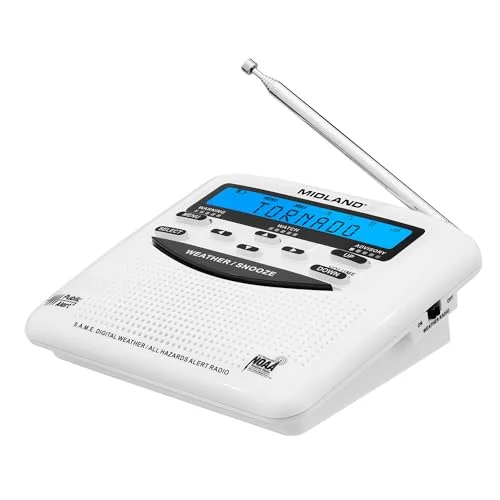
Midland WR120B NOAA Weather Radio, SAME Alerts, Battery Backup
The Midland WR120B is the radio to buy if you only buy one. It is a compact desktop unit that receives all the public weather channels around the clock, shows its menus in English, Spanish or French, and decodes more than 60 event types. Per the listing, you program the county and the unit stays silent for storms away from your address.
Think of the 2 a.m. situation. Power flickers, the router goes dark, your phone is on do-not-disturb. The WR120B is plugged in, so it is already listening. If the outage hits, it falls back to AA batteries and keeps monitoring. That is the whole value of the radio: it works without any decision from you.
Setup takes a few minutes. You look up your county code (the National Weather Service site lists these), enter it, choose a tone, and set the volume. The large buttons and backlit display help in the dark, which matters for older family members who may be the ones to respond when it sounds.
Where it falls short: there is no crank, no solar panel and no charging port. If the power stays out for a week and the batteries die, the WR120B goes quiet. Keep spare AA cells in the outage bin and you are covered for most situations.
Who it suits: families in a house or apartment, anyone with kids who sleep through a phone alert, and households with an elderly parent living alone who should have an audible alarm.
2. FosPower A1: Best Budget
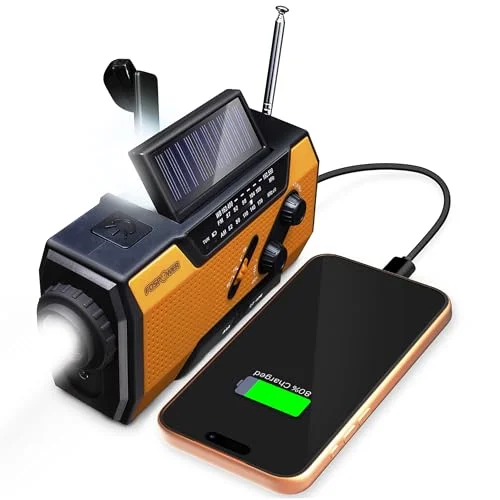
FosPower NOAA Emergency Weather Radio A1, 7400mWh Solar Hand Crank
The FosPower NOAA Emergency Weather Radio A1 is the budget pick because it covers the most outage jobs in a small package. Per the listing it receives NOAA weather and AM/FM, has a crank lever and a solar panel, accepts AAA batteries, and includes a 7400mWh (2000mAh) power bank for a phone or small tablet. It also has a flashlight and a four-LED reading light, plus an SOS alarm.
Picture four days snowed in. The power is out, your phone is at low charge, and you want to know when the roads will be plowed. Put the radio on a sunny windowsill by day, listen to the NOAA channel for updates and local AM stations for road news, and use the power bank to give the phone a short boost for a call.
What you give up: this radio does not list SAME county filtering, so it will not reliably wake you at night for a warning. Pair it with a desktop alert radio if the household needs that. Crank charging also takes real effort for modest output, so lean on sunlight and batteries and use the crank when you must.
Stock note: the listing was showing limited quantity when we checked, so look at availability before you plan around it.
Who it suits: anyone building an outage bin on a limited budget, a first-time buyer who wants one radio with a light and a charger, or a car or go-bag radio.
3. Midland WR400 Deluxe: Best Premium
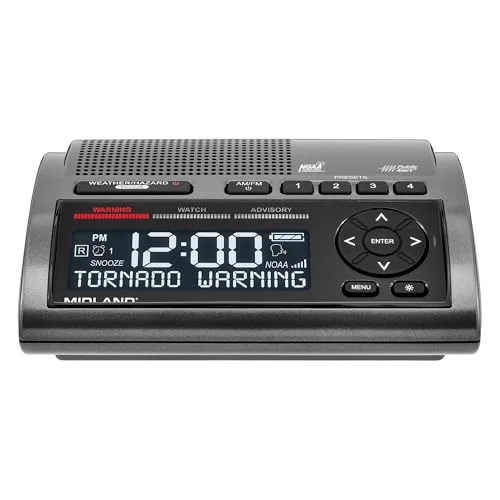
Midland WR400 Deluxe NOAA Weather Radio, SAME Alerts, Battery Backup
The Midland WR400 Deluxe is the upgrade over the WR120B. The extra money buys a higher county count (up to 25), a choice of alerts (an 85 dB siren, a voice announcement or a flashing LED light), and a USB port that charges a phone from the radio. It also scans the available weather channels and locks onto the strongest, and per the listing it offers 80 event types.
Those features matter in specific households. If a family member has trouble hearing, a flashing light can be the alert that gets noticed. If you have a parent in a neighboring county and work in a third, 25 counties lets one radio cover all three. If your outage routine includes charging a phone once a day, the USB port saves a cable trip to the power station.
It still has no crank or solar and relies on four AA batteries (not included) when the outlet fails. If your needs are a bedside alarm in one county, the WR120B does the same core job for less, and the WR400 is not worth the extra.
Who it suits: households covering more than one county, anyone with hearing difficulties in the home, and people who want the best of the desktop options and will use the USB port.
4. Kaito KA500 Voyager: Editor’s Pick
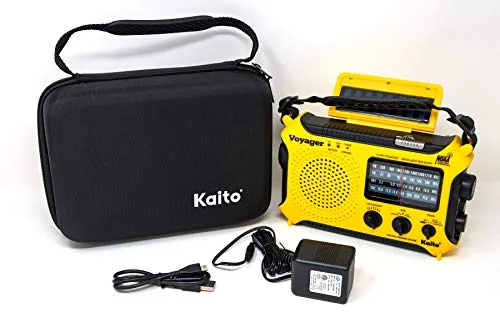
Kaito KA500 Voyager Solar/Crank Emergency AM/FM/SW/NOAA Weather Alert Radio
The Kaito KA500 Voyager is a portable solar/crank radio covering AM, FM, shortwave and NOAA weather, with an AC adapter and a storage case in the listing bundle. The shortwave band is the standout. On a long outage, local FM may be off the air, and having more bands gives you more chance of reaching a station that is still broadcasting.
We would choose this over the FosPower if you want a radio you will keep for years and are happy to learn its controls. The case helps it live in a go-bag or in the trunk next to the items in our winter car emergency kit guide, which is the best place for a radio if you are ever stuck in a vehicle for four hours.
The tradeoffs are size and weight, and the learning curve. Read the manual once before you need it, find out how the radio is switched to listen for weather alerts, and charge it before the storm using the AC adapter.
Who it suits: radio hobbyists, rural households likely to be cut off for days, and anyone who wants a single portable radio with the most bands.
5. RunningSnail SAME Radio: Best Value
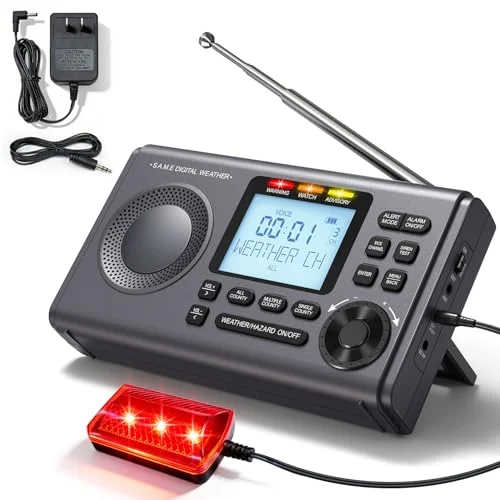
RunningSnail NOAA Weather Radio with 80+ Alerts and 23 SAME County Codes
The RunningSnail NOAA Weather Radio is a desktop alert radio with SAME programming for up to 23 county codes, 80-plus alert types, a siren listed up to 110 dB, and three AA batteries for backup. The listing says it runs for more than 54 hours on batteries during a power failure, which is a manufacturer figure we have not verified. The listing also advertises an external antenna and an external warning light, both useful in an apartment or basement where reception is weak.
It is a good choice for a second radio: put one in the kids’ hall and another in the main bedroom, or give one to a relative. Each alert type has its own on/off switch, so you can silence low-importance notices for the night while leaving tornado and flash flood warnings on.
The concerns are brand history and extras. It comes from a smaller brand than Midland, and it has no charging port or crank.
Who it suits: anyone who wants SAME alerts and a light flasher without the premium price, apartment dwellers with weak reception, and second-radio households.
| Spec | Midland WR120B NOAA Weather Radio, SAME Alerts, Battery Backup 9.1/10 | FosPower NOAA Emergency Weather Radio A1, 7400mWh Solar Hand Crank 8/10 | Midland WR400 Deluxe NOAA Weather Radio, SAME Alerts, Battery Backup 9/10 | Kaito KA500 Voyager Solar/Crank Emergency AM/FM/SW/NOAA Weather Alert Radio 8.3/10 | RunningSnail NOAA Weather Radio with 80+ Alerts and 23 SAME County Codes 8.4/10 |
|---|---|---|---|---|---|
| Type | Desktop alert radio | Portable crank/solar radio | Desktop alert radio | Portable crank/solar radio | Desktop alert radio |
| Alerts | SAME county filter, 60+ event types | — | — | — | — |
| Backup power | AA batteries | — | — | — | 3 AA batteries |
| Display | English, Spanish, French | — | — | — | — |
| Rating | 9.1/10 | 8/10 | 9/10 | 8.3/10 | 8.4/10 |
Prices change daily — tap Check Price for the current Amazon price.
Prices change daily — tap Check Price for the current Amazon price.
Building a Radio Plan for a Week Without Power
Hardly anyone needs five radios. Match the plan to the household:
- One bedroom, one house. A desktop alert radio by the bed (WR120B), AA spares in the outage bin.
- House with a spread-out family. Desktop alert radio upstairs, a second near the kids’ rooms or the main living area, and a crank/solar radio in the bin.
- Apartment on a low floor. A desktop radio with an external antenna (RunningSnail), tested at the window you sleep near.
- Rural or snowed-in. A crank/solar radio with many bands (Kaito Voyager) plus a desktop SAME radio.
- Car or go-bag. A small crank/solar radio such as the FosPower A1.
Our week without power checklist covers the rest of the supplies: water, light, food and heat.
If you are using any fuel-burning gear during an outage, such as a generator or a camp stove, keep it outdoors only, at the distance the label states, never in a garage or near windows or vents. Also run a battery-backed carbon monoxide alarm in the home. Radios are for information; they do not detect carbon monoxide.
FAQ
Do I need a SAME radio, or is a basic NOAA radio enough?
A basic NOAA radio plays the broadcast when you tune to it, and many sound an alarm for any alert on the channel. A SAME radio filters by county, so it only alerts you for warnings that apply to you. For a bedside radio that should wake the household, SAME is the better choice.
Will a hand-crank radio work if the batteries are dead?
Yes, if the radio has a working crank or solar panel, it can charge itself. Crank charging is slow, so a sunny window and fresh batteries are the better main sources, with the crank as the backup.
Can I use a weather radio inside a concrete apartment building?
Reception varies with distance from the transmitter and the building. Try the radio at your bedroom window, extend the antenna, and consider a model with an external antenna such as the RunningSnail. If reception is poor, a portable radio near a window may work better.
Are weather radios useful if I have phone alerts?
Phone alerts are useful, but they need cell service, a charged phone, and a notification setting that is turned on. A radio works on a separate system and can keep going when cell service fails, so having both is sensible.
How often should I change the backup batteries?
Check them when you change your smoke alarm batteries and whenever the radio shows a low-battery message. Keep a fresh spare set stored with the radio.
Can a weather radio charge my phone?
Some can. The FosPower A1 has a power bank, and the WR400 has a USB output. Treat it as a short top-up. For more, a power station is the better tool.
The Bottom Line
For most homes, buy the Midland WR120B for the bedroom and keep a FosPower A1 in the outage bin for the days after the storm. If you cover several counties or need a flashing light, the Midland WR400 is the upgrade. If you live somewhere remote, add the Kaito KA500 Voyager for its extra bands. Whichever radio you choose, program it, test it, and keep spare batteries beside it.